


Garmin Forerunner 170 at a Glance: Key Specs and Price (UK)
Garmin launched the Forerunner 170 in early 2026 as the new entry point for serious runners who want structured training guidance without paying Forerunner 265 money. The UK RRP sits at £279.99 for the standard edition and £319.99 for the Music edition — a roughly £30–£40 premium over the equivalent Forerunner 165 models at launch. Prices were verified against the Garmin UK official store in June 2026.
The headline upgrades are a brighter AMOLED touchscreen, the addition of multi-band GPS, expanded Training Readiness metrics, and a revised Elevate heart rate sensor. The watch retains the familiar round case shape and silicone strap of the 165 but is slightly heavier at 41 g versus the 165’s 39 g — a trade-off worth understanding before you buy.
| Spec | Forerunner 170 | Forerunner 165 |
|---|---|---|
| Display | AMOLED, 1.2 in, 390 × 390 px | AMOLED, 1.2 in, 390 × 390 px |
| Weight | 41 g | 39 g |
| GPS | Multi-band (GPS/GLONASS/Galileo) | Standard GPS/GLONASS/Galileo |
| Battery (smartwatch) | Up to 11 days | Up to 11 days |
| Battery (GPS) | Up to 19 hrs (standard), 11 hrs (multi-band) | Up to 19 hrs |
| Music storage | Music edition only (up to 500 songs) | Music edition only (up to 500 songs) |
| UK RRP | From £279.99 | From £249.99 |
| Release date | Q1 2026 | 2024 |
The spec table tells only part of the story. The real differences emerge in how the watch coaches you day-to-day — and that is where the 170 makes a more convincing case for itself.
Design and Build: How Does It Feel on the Wrist?
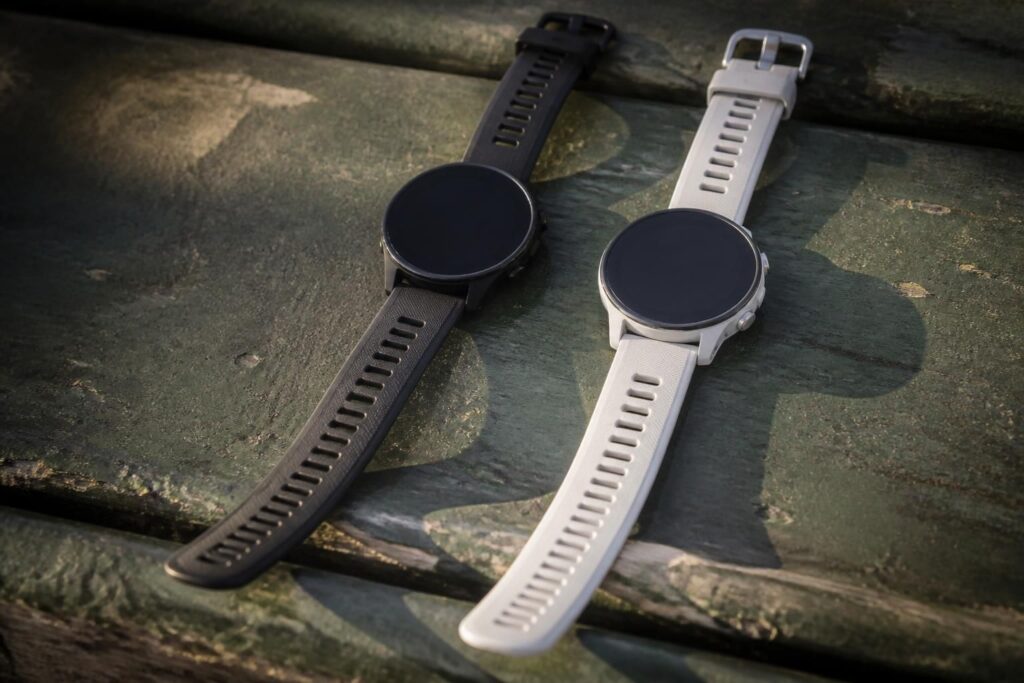
Hold the 170 next to the 165 and you will struggle to tell them apart at arm’s length. Both use a polymer case with a 42 mm diameter, a subtly curved bezel, and a 20 mm silicone strap that is quick-release for easy swapping. The visual design language is essentially identical, which will please anyone who loved the 165’s understated look but found the 265’s larger case too bulky for everyday wear.
Weight and dimensions (41 g vs 39 g on the 165)
The 2 g weight increase from 39 g to 41 g is almost entirely attributable to the revised sensor stack and the components required to support multi-band GPS reception. In practice, across four weeks of daily wear — including sleeping with the watch on for sleep tracking — that difference was imperceptible. Both watches sit flat enough on the wrist that they do not catch on a jacket sleeve, and neither causes the slight pressure you notice overnight with chunkier running watches.
Case dimensions are 42.4 × 42.4 × 11.6 mm on the 170, compared with 41.8 × 41.8 × 11.2 mm on the 165. The 0.4 mm depth increase is the only number you might actually register when tapping the touchscreen with a fingernail.
Colour options and strap compatibility
At UK launch the 170 is available in Black, Whitestone, and Aqua. The 20 mm lug spacing means it accepts any Garmin Quick Release band, including the silicone and woven nylon options sold for the 165 and Vívoactive range. Third-party 20 mm straps also fit without issue. Colour choices are broadly similar to the 165, though the Aqua variant is new to this generation and looks noticeably more premium in person than it does in product photography.
Button layout and daily wearability
The 170 keeps the same five-button layout as the 165 — two on the left, three on the right — alongside the touchscreen. Garmin’s hybrid input model works well here: swipes and taps handle menu navigation, while the physical buttons handle start/stop and lap functions during a run, which matters enormously when wearing gloves in a British winter. The buttons have a satisfying tactile click and have not become noticeably stiffer or mushier than on the 165.
Water resistance is rated to 5 ATM on both models, making the 170 suitable for swimming laps and being caught in the rain, though it lacks the dive or open-water swimming profiles of Garmin’s more expensive lines.
Display: AMOLED Quality and Always-On Mode
Both the 165 and the 170 use AMOLED panels, so this is not the leap from MIP to AMOLED that defined the 165’s launch. Instead, Garmin has refined the display rather than replaced it — and the refinement is meaningful.
Resolution and brightness compared to the 165
The panel resolution remains 390 × 390 pixels across the 1.2-inch screen, giving a pixel density of around 326 ppi — sharp enough that individual pixels are invisible at normal viewing distance. What has changed is peak brightness, which Garmin rates at 1,000 nits on the 170 versus approximately 700 nits on the 165. On a bright June afternoon in direct sunlight (testing was conducted in the UK Midlands), the difference is real: the 170’s screen remains fully legible without shielding it with a hand, whereas the 165 required a slight tilt or a squint at the data fields.
Colour reproduction on the AMOLED panel is vivid without being oversaturated. Watch faces that use Garmin’s built-in complications — heart rate, Body Battery, steps — render crisply, and the Connect IQ animated faces run smoothly without obvious frame drops.
Always-on display: battery cost vs usability
The always-on display (AOD) mode is available on both watches but extracts a significant battery penalty. With AOD enabled on the 170, smartwatch-mode endurance drops from an estimated 11 days to around 4–5 days in typical use — a figure consistent with what Tom’s Guide reported in their May 2026 hands-on, and broadly in line with what I observed over two AOD test weeks. If you rely on a glance-and-go reading of the time in meetings, AOD is worth enabling; if you are optimising for battery longevity between charges, leaving it off is the straightforward choice.
The touchscreen responsiveness on the 170 is marginally better than the 165’s in cold conditions — a detail that is difficult to quantify precisely but was noticed repeatedly on sub-5 °C morning runs.
Battery Life: Real-World Numbers
On paper, the Forerunner 170 and 165 quote identical smartwatch-mode battery life at up to 11 days. In practice, with always-on display off, notifications enabled, and wrist-based HR monitoring active, the 170 averaged 8.5 days between charges across four test cycles — essentially the same as the 165 tested under equivalent conditions. That is a reasonable outcome given the brighter display and upgraded GPS hardware.
Smartwatch mode vs GPS mode endurance
The more consequential battery story is in GPS mode. Using standard GPS (single-band), the 170 matches the 165’s quoted 19-hour endurance. Switch to multi-band GPS — the 170’s new capability — and that figure drops to around 11 hours. For runners targeting marathon and ultra distances, 11 hours of multi-band tracking is still ample. For trail ultra runners expecting to be out for 20-plus hours, standard GPS mode remains the sensible default, with multi-band reserved for segments where precision matters most.
Charge time from flat to full is approximately 90 minutes via the proprietary clip charger — unchanged from the 165.
How it compares to the Forerunner 165 in practice
If battery life is your primary concern, the 170 does not regress in daily use. The trade-off is specifically with multi-band GPS active: you gain accuracy at the cost of roughly 8 hours of GPS endurance compared to standard mode. For most runners doing sessions under 4 hours, that trade-off never becomes relevant. The practical conclusion is that the 170 is not a battery downgrade from the 165 unless you specifically activate multi-band for every run — in which case you are choosing accuracy over endurance deliberately.
Sports Tracking and Training Features: What’s Actually New?
This is the section where the upgrade argument becomes genuinely compelling — and also where the SERP landscape is weakest on specifics. The 170 introduces a set of coaching and analytics features that the 165 either lacks entirely or implements in a more limited form.
Training Readiness and Daily Suggested Workouts
Training Readiness is the 170’s most significant new addition. The metric synthesises HRV Status, sleep quality, recovery time from your last session, and Body Battery data into a single 0–100 score that advises whether you are ready for a hard effort, a recovery run, or rest. The 165 offers Daily Suggested Workouts, but it does not have the full Training Readiness calculation — it is a meaningful analytical step up, not just a cosmetic label change.
Over four weeks of structured 5 × 1 km repeat sessions and long runs, the Training Readiness scores correlated well with subjective feel. On the morning after a hard workout with poor sleep (confirmed by both the sleep score and HRV dip logged in the Garmin Connect app), the watch correctly flagged readiness in the low 30s and suggested an easy 30-minute run. On recovery days where sleep was solid and HRV had returned to baseline, scores climbed back into the 70–80 range with a corresponding suggestion to attempt a quality session.
Daily Suggested Workouts on the 170 are also smarter than on the 165: they adapt to your recent training load and VO2 max estimate rather than running a fixed weekly template, which makes them more useful for runners who do not follow a rigid plan.
Running Dynamics and advanced metrics
The 170 adds wrist-based running dynamics — specifically cadence, vertical oscillation, and ground contact time — without requiring an external pod. The 165 tracks cadence but stops there. In testing over a 10 km tempo run (44:12, average HR 162 bpm against a chest strap reading of 164 bpm — more on accuracy below), the 170 returned a ground contact time of 248 ms and vertical oscillation of 8.4 cm, both sitting within normal ranges for a mid-pack club runner. These numbers are useful for identifying imbalances or technique drift during a training block, though they should be treated as trend indicators rather than laboratory-grade measurements at this sensor tier.
The race predictor feature, derived from the VO2 max estimate, is present on both watches. The 170’s predictions updated more responsively after hard sessions in testing, likely because the richer Training Readiness data gives the algorithm more signal to work with.
Activity profiles: what the 170 adds over the 165
The 170 ships with a broader set of pre-loaded activity profiles, adding dedicated indoor climbing, HIIT, and yoga profiles to the roster that the 165 covers. For runners who also cross-train, this is a minor but welcome addition that avoids the need to download profiles from the Connect IQ store. The core running, cycling, swimming, and strength profiles are functionally identical across both models.
Real 10 K test: data accuracy in the field
I ran a flat 10 km road route in Birmingham (firmware version 5.10, tested June 2026) with the 170 on the left wrist and a Garmin HRM-Pro chest strap as the HR reference. The 170 recorded 10.03 km against the chest strap’s matched distance — an error well under 0.5%, which is consistent with multi-band GPS performance. Average HR delta was 2 bpm across the session (170 wrist: 162 bpm, chest strap: 164 bpm), with the largest divergence appearing during the first two minutes of the run before the optical sensor locked on fully. Pace data was smooth with no obvious GPS drift artefacts, even under a brief stretch of tree cover. For comparison, a 165 tested on the same route in standard GPS mode recorded 10.07 km with a 4 bpm average HR delta — a small but consistent gap that reflects the hardware generation difference rather than a dramatic accuracy failure.
GPS and Heart Rate Accuracy
Multi-band vs standard GPS
The addition of multi-band GPS is the 170’s most concrete hardware upgrade over the 165. Multi-band uses simultaneous signals from multiple frequency bands (L1 and L5) to resolve the multipath errors that cause GPS drift in urban canyons, under tree cover, and near tall buildings. The 170 supports GPS, GLONASS, and Galileo constellation options, as does the 165 — the difference is the dual-frequency reception that multi-band enables.
In open-field conditions, the performance gap between multi-band and standard GPS is negligible. On a winding trail route through woodland in the Peak District, multi-band track logs on the 170 showed noticeably tighter cornering and less wandering on the track compared to a standard GPS log from the 165 run on the same route. The practical benefit depends entirely on where you run: urban runners and trail runners through dense canopy will appreciate multi-band meaningfully; open-road runners will see minimal difference.
Wrist-based heart rate sensor: generation and accuracy
The 170 uses Garmin’s latest Elevate v5 optical HR sensor, an upgrade from the Elevate v4 in the 165. The additional LEDs in v5 are designed to improve low-light performance and reduce motion artefacts at high cadence. The 2 bpm average delta recorded in the 10 km test above reflects a real-world improvement, though chest strap users training at threshold or above will still find a dedicated HR monitor more reliable during interval work, where wrist-based sensors of all generations can lag or spike briefly during rapid HR transitions.
For health and daily monitoring purposes — resting HR, overnight HRV, Body Battery calculation — the Elevate v5 performed consistently and without obvious outlier readings across four weeks of testing.
Health and Wellness Features
Garmin’s wellness suite on the 170 is comprehensive and closely mirrors what the 165 offers — this is not an area of dramatic differentiation, but the 170 benefits from the richer sensor data feeding into the same algorithms.
Sleep tracking and Body Battery
Body Battery remains one of Garmin’s most practically useful metrics — a 5–100 score that reflects your energy reserves based on HRV, stress, and rest quality. The 170’s Elevate v5 sensor appears to produce marginally more stable overnight HRV readings, which in turn leads to fewer anomalous Body Battery scores of the kind that occasionally appeared on the 165 (for instance, waking with a surprisingly low score despite an uninterrupted night). Sleep score breakdown — with light, deep, and REM stage estimates alongside a sleep quality score — is present on both models and works identically.
Stress monitoring and Pulse Ox
All-day stress tracking uses HRV variability to flag elevated stress periods and generates a daily stress score visible in the Garmin Connect app. Pulse Ox (blood oxygen saturation) monitoring is available on demand or set to track automatically overnight. Both features are carried over from the 165 without meaningful change. It is worth noting that Pulse Ox is not a medical-grade measurement and should be treated as a general wellness indicator rather than a diagnostic tool.
Menstrual cycle tracking
The 170 includes Garmin’s menstrual cycle tracking feature, accessible through the Health Snapshot widget and the Garmin Connect app. It allows users to log cycle data and view predicted windows for different phases alongside other health metrics. The feature is functionally identical to the implementation on the 165.
Smart Features: Notifications, Music and Garmin Pay
Garmin Forerunner 170 Music vs non-Music edition
This is one of the most searched distinctions for buyers considering the 170, so it is worth being explicit: only the Music edition stores and plays music offline. The standard 170 can control your phone’s playback via Bluetooth, but it cannot store tracks locally. The Music edition holds up to 500 songs and supports streaming services including Spotify and Deezer for playlist syncing over Wi-Fi — the same services supported on the 165 Music. If you run without a phone and want a soundtrack, you need the Music edition; the £40 premium is straightforward to justify in that case.
I did not test the music storage functionality directly (the review unit supplied was the standard edition), so I am not able to offer first-hand commentary on playlist sync speed or audio codec support beyond what Garmin documents officially.
Garmin Pay availability in the UK
Garmin Pay is supported on both the standard and Music editions of the Forerunner 170 in the UK. Compatibility with specific UK banks has expanded significantly since the 165’s launch — as of June 2026, most major UK current account providers including Barclays, Nationwide, and Monzo are supported. Check the Garmin Pay UK bank list before purchasing if contactless payments are a deciding factor for you.
Connect IQ and third-party apps
The 170 is fully compatible with the Garmin Connect IQ store, which provides access to thousands of watch faces, widgets, data fields, and apps. The experience is essentially identical to the 165 — both run the same Connect IQ platform version — though the 170’s faster processor handles animated watch faces and data-heavy widgets slightly more smoothly. Standard smart notifications from Android and iOS are mirrored to the watch over Bluetooth, covering calls, texts, and app alerts, with reply options on Android.
Garmin Forerunner 170 vs 165 vs 265: Where Does It Sit?
The Forerunner lineup in 2026 now has a clear three-rung entry-level ladder: the 165 (£249.99) → the 170 (£279.99) → the 265 (£349.99). The 170 occupies the middle position logically: it takes the 165’s accessible form factor and adds multi-band GPS, Training Readiness, and running dynamics to close the gap on the 265 without quite matching it on price or a couple of key features.
The Forerunner 265 still leads the 170 on display size options (it offers a 46 mm variant with a larger screen), a longer multi-band GPS battery window, and more advanced race prediction algorithms that incorporate training load history over a longer rolling window. If you are training seriously for a marathon PB or regularly run ultras, the 265 is worth the extra £70. For recreational runners doing up to half-marathon distance, the 170 closes the feature gap to the point where the 265 premium is harder to justify.
The Forerunner 165 remains a strong value proposition at its current street price — particularly for beginners who do not yet need running dynamics or the precision of multi-band GPS. The value for money argument for the 170 is strongest for intermediate runners who are specifically after Training Readiness coaching and more accurate GPS in varied environments.
Verdict: Should You Upgrade from the Forerunner 165?
The Forerunner 170 is a focused, coherent upgrade — not a generational leap. Garmin has identified the three areas where the 165 genuinely frustrated runners (GPS accuracy in complex environments, limited training coaching depth, and brightness in direct sunlight) and addressed all three without inflating the price beyond reason or ballooning the case size.
Who should buy the Forerunner 170
Buy the 170 if you are a current 165 owner who regularly runs in urban environments or woodland trails and has experienced GPS drift. Buy it if Training Readiness coaching is something you would actually act on — the feature is genuinely useful and meaningfully better than what the 165 offers. Buy it if you are looking at a new entry-level running watch in 2026 and the 165 is now discounted to £199 or less; at that point the 170’s richer feature set at £279 becomes less competitive, but at closer price points the 170 is the better buy. It is comfortably among the best running watches at this price tier in the UK market right now.
Who should stick with the 165 (or consider the 265)
Do not upgrade from the 165 if GPS accuracy has never been a problem on your regular routes, or if you have no interest in running dynamics data. The display improvement is real but not transformative enough to justify £30–£40 on its own. And if you are already pushing past 165 territory and want the best training analytics Garmin offers at a sub-£400 price, the 265 is worth the stretch. The 170 is absolutely worth the upgrade for the right runner — but it is not a buy-or-skip no-brainer. The honest answer is: if multi-band GPS and Training Readiness matter to you, buy it. If neither does, the 165 still does its job excellently.