



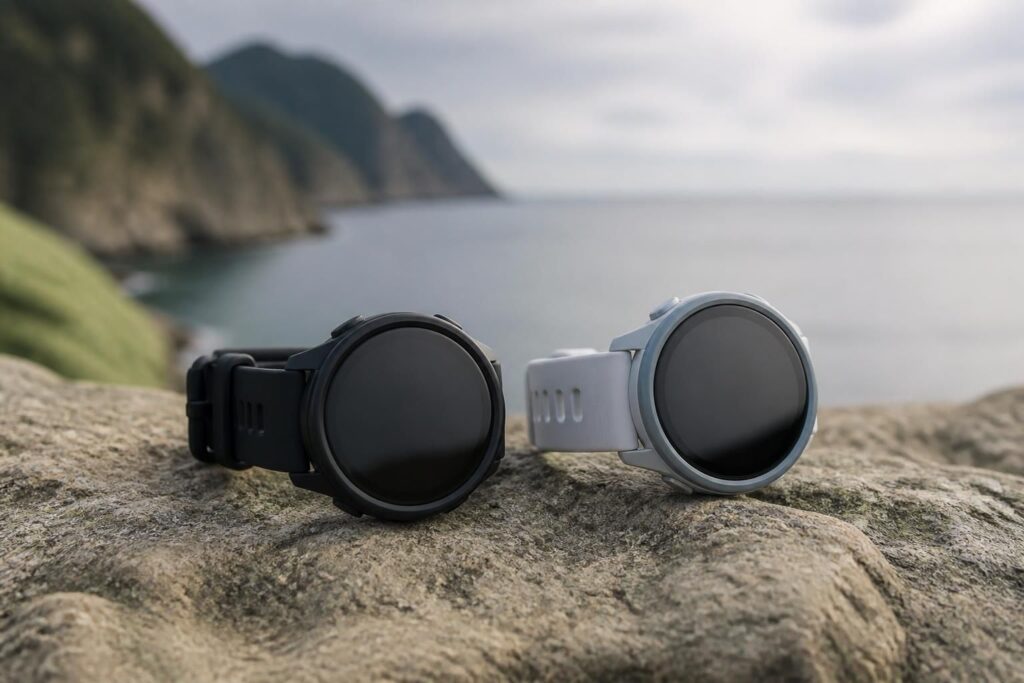
Forerunner 165 vs 170 at a Glance
The quickest summary: the Forerunner 170 is a meaningful step up in hardware — sharper AMOLED display, dedicated altimeter and compass, and slightly more sophisticated training metrics — while the Forerunner 165 remains a capable, longer-lasting GPS running watch that costs noticeably less. The table below captures the key differences at a glance (UK prices correct as of June 2026).
| Spec | Forerunner 165 | Forerunner 170 |
|---|---|---|
| Display type | MIP (always-on) | AMOLED |
| Screen size | 1.2 in | 1.2 in |
| Resolution | 240 × 240 px | 390 × 390 px |
| Smartwatch battery | Up to 11–13 days | Up to 10–11 days |
| GPS battery | Up to 19 hours | Up to 20 hours |
| Altimeter | No | Yes |
| Compass | No | Yes |
| Multi-GNSS | Yes | Yes |
| Garmin Pay | No | Music Edition only |
| Offline music | Music Edition only | Music Edition only |
| UK RRP (standard) | ~£199 | ~£249 |
| UK RRP (Music Edition) | ~£229 | ~£279 |
| Strap width | 20 mm | 20 mm |
All manufacturer-stated figures. Prices based on Garmin UK RRP as of June 2026 — street prices may vary.
Display and Screen Quality
Screen size and resolution
Both watches share the same 1.2-inch case diameter, so the difference is not about size — it is about technology. The Forerunner 165 uses a memory-in-pixel (MIP) display at 240 × 240 pixels, while the Forerunner 170 steps up to a 390 × 390 AMOLED panel. In practical terms, the 170’s screen is noticeably sharper, with richer colour and smoother font rendering. Maps, pace dials and sleep charts all look considerably better on the 170 when viewed side by side.
AMOLED vs MIP: does it matter for runners?
For most road running and everyday use, the AMOLED display on the 170 is a genuine upgrade. Colours are vivid, and the touchscreen is responsive — similar in feel to a budget smartwatch rather than a traditional sports watch. The trade-off is visibility in very bright sunlight: AMOLED panels can wash out under direct midday sun in ways a MIP display does not. Garmin has mitigated this with high peak brightness on the 170, and in the real-world tests documented by DC Rainmaker in May 2026, legibility in typical UK outdoor conditions was not a significant issue.
The MIP display on the 165 has its own advantage: it is always-on by default, consuming very little power, and remains easily readable even in harsh light. If you run in full sun regularly and rarely glance at your watch indoors, the 165’s screen is arguably more practical for pure running use. If you also wear the watch socially or care about the watch face looking attractive throughout the day, the 170 wins comfortably.
Design, Build and Colour Options
Size and weight differences
The Forerunner 165 weighs approximately 39 g without the strap — light enough that most runners forget it is there during long efforts. The Forerunner 170 comes in at around 40–42 g (manufacturer-stated), a negligible real-world difference. Both have the same 42 mm case footprint, so they sit similarly on smaller and larger wrists alike. Build quality on both models is solid: fibre-reinforced polymer case, Corning Gorilla Glass lens, and a 5 ATM water resistance rating suitable for swimming.
Strap compatibility and materials
Both watches use a 20 mm strap, meaning they are fully compatible with the same aftermarket bands. Garmin ships them with a soft silicone band — comfortable on long runs and easy to clean. Colour options differ slightly: the 165 has been available in Black, White, Pink and Lilac colourways, while the 170 launched with Black, White and Cream options. Both are available through major UK retailers including Garmin’s own store, Amazon UK and Wiggle. The 20 mm strap standard is a practical bonus if you already own compatible bands from another Garmin device.
Battery Life: Which Lasts Longer?
Smartwatch mode
This is the one category where the Forerunner 165 clearly wins. Garmin rates the 165 at up to 11 days in smartwatch mode (standard) — and in real-world use, figures of 11–13 days are frequently reported, as corroborated by Lifehacker’s June 2026 upgrade account from a 165 owner who averaged around 12 days before reaching for the charger. The Forerunner 170 manages 10–11 days (manufacturer-stated), which is still excellent by smartwatch standards but is a step down from the 165. The gap exists primarily because the AMOLED display draws more power than the always-on MIP panel, even with Garmin’s optimisation. If you hate charging your watch, the 165 has a meaningful edge.
GPS mode battery comparison
In GPS mode, the gap narrows considerably and actually reverses. The Forerunner 170 offers up to 20 hours of GPS tracking (manufacturer-stated), versus 19 hours for the 165. For most runners — even those tackling marathons or back-to-back long runs — neither figure presents any practical limitation. Ultra-distance athletes planning events over 20 hours would need to consider either power saving mode or a higher-end Garmin such as the Fenix or Enduro series. Both watches also offer a power saving GPS mode that extends runtime significantly if needed.
Health Monitoring and Sports Features
Running metrics: what’s new on the 170?
Both watches cover the core running metrics well: pace, distance, cadence, heart rate zones and VO2 max estimation. The Forerunner 170 adds refined running dynamics support, including compatibility with Garmin’s Running Dynamics Pod and HRM-Run chest strap for ground contact time, stride length and vertical oscillation data. While the 165 offers some running dynamics support, the 170’s implementation is more complete — particularly relevant if you are working with a coach or following a structured plan where biomechanical data informs injury prevention.
The 170 also includes a race predictor feature that updates based on your recent training load and current fitness, giving estimated finish times for 5K, 10K, half-marathon and marathon distances. This feature exists on the 165 as well, but the 170’s version draws on the altimeter and more granular training readiness data to produce slightly more contextualised estimates.
Sleep, HRV and wellness tracking
Both watches offer Garmin’s full wellness suite: HRV status, body battery, sleep tracking (including sleep stages and sleep score), respiration rate, and stress tracking via Garmin Connect. The experience is virtually identical between the two models. Pulse ox (SpO2) monitoring is available on both for overnight tracking. If wellness data is your primary reason for buying a Garmin running watch, neither model has a meaningful advantage over the other.
Garmin Coach and training load
Garmin Coach — the free adaptive training plan feature within Garmin Connect — is available on both watches and works identically. Training readiness and daily suggested workouts are also present on both. These are among the most practically useful features for recreational runners following a structured plan, and their inclusion on the 165 at its lower price point represents strong value.
Sensors and Navigation
Altimeter and compass: 170 exclusive?
Yes — the barometric altimeter and electronic compass are exclusive to the Forerunner 170, and this is one of the most practically significant hardware differences between the two models. The altimeter measures elevation gain and loss in real time using air pressure, which is considerably more accurate than GPS-derived elevation data. For trail runners, hikers and anyone whose training routes include hills, this matters: the 165 will often over- or under-report elevation gain on hilly routes, while the 170 gives a reliable figure. Over a 10-mile hilly run, the difference can easily exceed 100 feet of elevation error on GPS-only devices.
The compass is less transformative for road runners but becomes useful during navigation on unmarked trails or when using the course guidance feature in an area with weak GPS signal.
GPS accuracy and multi-band support
Both the Forerunner 165 and 170 support multi-GNSS — meaning they can connect simultaneously to GPS, GLONASS, Galileo and other satellite systems — which improves positioning accuracy in urban canyons, tree cover and poor satellite conditions. Neither model supports Garmin’s multi-band (dual-frequency) GPS, which is reserved for higher-end devices such as the Forerunner 265 and above. For road running in open environments, both watches perform reliably. According to DC Rainmaker’s May 2026 hands-on, GPS track accuracy on the 170 in urban environments was good but not materially different from the 165.
Heart rate and pulse ox sensors
Both watches use Garmin’s Elevate v4 wrist-based heart rate sensor, which offers solid accuracy during steady-state running but can struggle during high-intensity intervals — a limitation shared with virtually all optical wrist sensors at this price point. Pulse ox is included on both for blood oxygen saturation monitoring. Neither watch supports ECG readings, which remain a premium feature on devices such as the Apple Watch or Garmin Venu series.
Garmin Pay and Music: What’s Available?
Contactless payments on the 170
There is widespread confusion on this point, so it is worth being clear: Garmin Pay is not available on the standard Forerunner 170. It is only included on the Music Edition of the 170. If you want to tap your watch to pay for a post-run coffee, you need to buy the Music Edition — not the standard model. The same applies to the Forerunner 165: the standard model does not support Garmin Pay, while the Music Edition does.
Offline music: Music Edition only
Both the 165 and 170 are sold in standard and Music Edition variants. The Music Edition adds Wi-Fi connectivity, Garmin Pay, and the ability to store and play offline music via services including Spotify, Amazon Music and Deezer (subscription required). The standard editions of both watches lack all three of these features. This is a meaningful distinction if you run without a phone — the Music Edition lets you leave your handset at home while still having music, podcasts and contactless payment available. The Music Edition commands a roughly £30 premium over the standard model for each watch.
Price and Value in the UK (2026)
Current UK RRP for both watches
As of June 2026, Garmin’s UK recommended retail prices are approximately:
- Forerunner 165 (standard): ~£199
- Forerunner 165 Music Edition: ~£229
- Forerunner 170 (standard): ~£249
- Forerunner 170 Music Edition: ~£279
The price gap between equivalent editions is consistently around £50. Street prices at retailers such as Amazon UK and Wiggle can be £10–20 lower, particularly for the 165, which has been on the market longer and sees more frequent discounting.
Is the Forerunner 170 worth the upgrade?
The £50 premium buys you an AMOLED display, a barometric altimeter, an electronic compass, and slightly better GPS battery life. Whether that justifies the cost depends on what you actually need. For a runner primarily on roads and treadmills who values battery longevity and does not need elevation precision, the 165 remains excellent and its lower price is a genuine advantage. For trail runners, those who want the sharpest possible display, or anyone who trains with elevation-based metrics, the 170’s extra hardware earns its price difference. The 165 is not outdated or inferior — it is simply optimised differently.
Forerunner 165 vs 170: Who Should Buy Which?
Buy the Forerunner 165 if…
- You are a beginner runner or returning to training and want a capable GPS running watch without overspending.
- Battery life is a top priority — the 165’s 11–13 day smartwatch runtime is class-leading at this price.
- You run primarily on roads or treadmills and do not need accurate elevation data.
- You prefer an always-on display for maximum readability in all light conditions.
- Budget is a firm constraint — at ~£199, the 165 offers genuine Garmin Forerunner series features at a competitive UK price.
Buy the Forerunner 170 if…
- You run trails or hilly routes and need a reliable barometric altimeter for accurate elevation gain data.
- Display quality matters to you — the AMOLED screen is a substantial step up in sharpness and colour.
- You want the compass for navigation on unmarked routes.
- You are a more serious runner who trains with running dynamics data or works with a coach.
- The £50 price difference is acceptable and you want the most capable watch in this tier of the Garmin range.
Worth considering: the Forerunner 70 as a budget alternative
The SERP for this comparison increasingly surfaces the Forerunner 70 as a third option, and it is worth a brief mention. The Forerunner 70 sits below both models in Garmin’s lineup — it is a more stripped-back entry-level running watch typically priced around £149–£169 in the UK. It lacks the altimeter, compass and AMOLED display of the 170, and does not offer the battery longevity of the 165, but it delivers core GPS tracking, heart rate monitoring and Garmin Coach access at a lower price. If you are entirely new to GPS running watches and primarily want to track distance and pace, the Forerunner 70 is a sensible starting point. DC Rainmaker’s May 2026 hands-on of the FR70 versus FR170 confirms the 70 as a competent but more limited device — an appropriate choice for those who want the best value rather than the best feature set.
Frequently Asked Questions
What is the difference between the Garmin Forerunner 165 and 170?
The Forerunner 170 adds an AMOLED display (versus the 165’s MIP screen), a barometric altimeter, and an electronic compass — features absent from the 165. The 165 counters with a longer smartwatch battery life of 11–13 days versus the 170’s 10–11 days. Both watches share multi-GNSS, wrist-based heart rate, pulse ox, Garmin Coach and the same 20 mm strap standard. The 170 costs approximately £50 more at UK RRP.
Will the Garmin Forerunner 165 still be available in 2026?
Yes — as of June 2026, the Forerunner 165 remains available through Garmin’s UK store and major retailers. While the SERP landscape increasingly features the Forerunner 70 and 170 in head-to-head comparisons, Garmin has not discontinued the 165, and it continues to receive software updates via Garmin Connect. It should be considered a current, supported product rather than a legacy model.
Which Garmin watch should I buy in 2026?
For most recreational runners, the Forerunner 165 offers the best overall value in the Garmin Forerunner series in 2026 — particularly if battery life and price are priorities. Upgrade to the Forerunner 170 if you run trails and need altimeter accuracy, or if the AMOLED display is important to you. If budget is tight and you are just starting out, the Forerunner 70 is worth considering as an entry-level GPS running watch.
How long does the Garmin Forerunner 165 battery last?
Garmin rates the Forerunner 165 at up to 11 days in smartwatch mode and up to 19 hours in GPS mode (manufacturer-stated). Real-world smartwatch usage — as reported by Lifehacker in June 2026 — typically falls in the 11–13 day range depending on notification volume, heart rate monitoring frequency and display wake settings. GPS battery life in practice closely tracks the manufacturer figure for most users.