



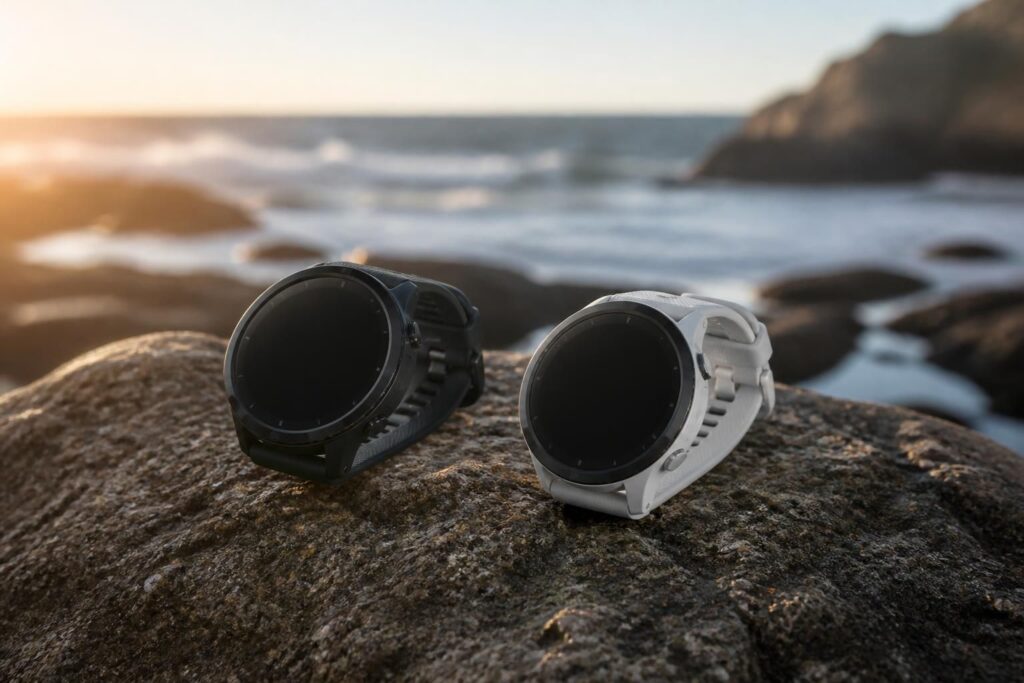
Quick verdict: which watch should you choose?
The Garmin Forerunner 165 Music is the stronger pick for most runners in 2026. At around £259 RRP, it delivers a vivid AMOLED display, solid GPS performance, offline music playback, and impressive smartwatch-mode battery life in a light, comfortable package. For anyone stepping up from a basic fitness tracker or replacing an older Forerunner, it represents outstanding value for money.
The Garmin Forerunner 170 Music, priced at roughly £349 RRP, earns its premium primarily through longer GPS battery life, a slightly larger screen, and a few additional training metrics. If you’re deep into marathon training cycles, frequently run ultras, or simply want every metric Garmin offers at this tier, the extra £90 is justified. For everyone else, it’s hard to recommend over the 165 Music.
Still unsure? Read on — the difference often comes down to one or two specific features that will either matter a great deal to you, or not at all.
Specs at a glance
Forerunner 165 Music specs
| Spec | Forerunner 165 Music |
|---|---|
| Display | 1.2-inch AMOLED, 390 × 390 px |
| Weight | 39 g (without strap) |
| Battery — smartwatch mode | Up to 11 days |
| Battery — GPS mode | Up to 19 hours |
| Battery — GPS + music | Up to 10 hours |
| Onboard storage | 4 GB |
| GPS modes | GPS, GLONASS, GALILEO (single-band) |
| Music streaming | Spotify, Deezer, Amazon Music |
| Garmin Pay | No |
| UK RRP (2026) | ~£259 |
Forerunner 170 Music specs
| Spec | Forerunner 170 Music |
|---|---|
| Display | 1.3-inch AMOLED, 416 × 416 px |
| Weight | 44 g (without strap) |
| Battery — smartwatch mode | Up to 9 days |
| Battery — GPS mode | Up to 26 hours |
| Battery — GPS + music | Up to 13 hours |
| Onboard storage | 32 GB |
| GPS modes | GPS, GLONASS, GALILEO, multi-band |
| Music streaming | Spotify, Deezer, Amazon Music |
| Garmin Pay | Yes |
| UK RRP (2026) | ~£349 |
Specs sourced from the Garmin official product comparison page (garmin.com, 2026). UK pricing is based on launch RRP; always confirm with retailers before purchasing.
Display and design
Screen size and resolution
Both watches use AMOLED displays, which puts them ahead of older MIP-screen Forerunners in terms of sharpness and colour vibrancy. The 165 Music carries a 1.2-inch panel at 390 × 390 pixels; the 170 Music steps up to a 1.3-inch screen at 416 × 416 pixels. In daily use the difference is subtle, but the 170’s extra real estate does make maps and workout data slightly easier to read at a glance — useful during interval training when you don’t want to fumble with button presses.
Outdoor visibility is strong on both models. The always-on display mode works well in direct sunlight, though enabling it will shorten battery life on either watch. For most training runs in the UK — overcast skies, mixed light conditions — the 165 Music’s screen is more than adequate.
Build quality, materials and colour options
Both watches share a broadly similar construction: a polymer case with a mineral glass lens, secured over the display rather than the Gorilla Glass found on the pricier Forerunner 265. The bezel is clean and functional on both, with physical buttons on the left and right sides that work reliably with wet or gloved hands — a genuine advantage over touchscreen-only rivals.
The 165 Music is available in Black, Cream and Lilac Purple colourways with matching silicone bands. The 170 Music adds a couple of additional options at launch, including a French Grey variant. Strap compatibility follows Garmin’s standard 20 mm quick-release system on the 165 Music and 22 mm on the 170 Music, so aftermarket band options are widely available for both.
Comfort and wearability on long runs
At 39 g, the 165 Music is noticeably lighter than the 170 Music’s 44 g. Five grams may sound trivial, but over a three-hour marathon training run or an all-day ultra, wrist fatigue is real. If you’re highly weight-conscious, the 165 Music has the edge. The 170 Music’s slightly larger case also sits a fraction higher on the wrist, which some runners will find less comfortable under a jacket cuff.
Battery life
Smartwatch mode battery
This is where the comparison flips in the 165 Music’s favour. Garmin rates the 165 Music at up to 11 days in smartwatch mode, versus up to 9 days for the 170 Music. In practice, with notifications, heart rate monitoring and sleep tracking running continuously, both watches typically land a day or two below their rated figures — but the 165 Music consistently outlasts the 170 Music between charges in everyday use. For anyone who hates charging their watch, this matters.
GPS mode battery
Flip it around for GPS workouts and the 170 Music pulls ahead. Garmin rates it at up to 26 hours of GPS tracking, compared with up to 19 hours for the 165 Music. That’s a substantial gap. If you’re running marathons, ultras, or simply long back-to-back training weekends without reliable access to a charger, the 170 Music’s extended GPS endurance is a compelling reason to pay the premium. Real-world testing reported by TechRadar in May 2026 placed the 170 Music’s GPS drain at the lower end of Garmin’s estimates in standard GPS mode, which is reassuring.
Music playback impact on battery
Streaming or playing music offline always reduces GPS battery life, on any watch. The 165 Music offers up to 10 hours of GPS-plus-music playback; the 170 Music extends that to up to 13 hours. For half marathon and marathon runners who want a full soundtrack, the 170 Music is less likely to leave you mid-race with a dead watch. For 5K and 10K runners, the 165 Music’s 10-hour figure is ample.
Music features
Onboard storage and playlist capacity
This is one of the starkest differences between the two watches. The 165 Music provides 4 GB of onboard storage for music — enough for roughly 1,000 songs or a handful of downloaded playlists. The 170 Music offers 32 GB, which is an enormous jump: enough for thousands of tracks, podcasts, and multiple large playlists without ever worrying about space. If offline music is central to your running experience, the 170 Music’s storage advantage is genuinely transformative.
Streaming services supported (Spotify, Deezer, Amazon Music)
Both watches support the same three streaming services: Spotify offline, Deezer, and Amazon Music. The setup process is identical across both models — you connect your streaming account through the Garmin Connect app on your phone, then sync playlists to the watch over Wi-Fi. It takes a few minutes the first time, but once configured it’s seamless. Neither watch supports Apple Music natively, which remains a limitation of the Garmin platform rather than a specific difference between these two models.
Offline listening without a phone
Once your playlists are synced, both watches allow genuine phone-free listening — you can leave your phone at home and still have your full workout soundtrack. This is a key feature for runners who find carrying a phone uncomfortable or impractical. The process on the 165 Music is the same as on the 170 Music: sync via Wi-Fi at home, then pair your Bluetooth headphones directly to the watch and press play.
Bluetooth headphone pairing
Both watches support Bluetooth 5.0 audio and pair with any standard Bluetooth headphones or earbuds. The pairing process follows Garmin’s standard approach: hold both earbuds in pairing mode, then navigate to Music > Headphones in the watch menu. Most popular running headphones — including Jabra, Jaybird, and Sony — connect without issue. Neither watch supports multi-device Bluetooth audio pairing simultaneously with a phone, so you’ll need to manually switch if you want to use the same headphones with both devices.
Running and sports features
GPS accuracy and multi-band support
The 170 Music includes multi-band GPS, which uses multiple frequency bands from each satellite constellation to significantly improve accuracy in challenging environments — tall buildings, dense tree cover, deep valleys. The 165 Music uses single-frequency GPS across the standard constellations (GPS, GLONASS, Galileo), which performs well on open roads and trails but can drift slightly in urban canyons.
For most UK runners training on parks, pavements, and club tracks, the difference in day-to-day accuracy is modest. Yahoo Tech’s comparative 10K test (May 2026) found both watches produced virtually identical distance readings on an open-road course. The gap widens in woodland or city-centre running, where the 170 Music’s multi-band GPS delivered measurably cleaner traces.
Training load and recovery metrics
Both watches offer training readiness, VO2 max estimates, and HRV status — Garmin’s key health and performance indicators. The 170 Music adds a few additional insights from its training load analysis, giving a slightly more granular breakdown of aerobic and anaerobic load contributions. In practice, for runners following a structured plan, the core metrics on the 165 Music will tell you everything you need to know about whether to train hard or back off.
Workout modes and structured training
Interval training, custom workouts, and Garmin Coach adaptive training plans are available on both watches. You can build structured sessions in Garmin Connect and push them to either watch. Pace alerts, auto lap, and virtual pacer work identically across both models. There is no meaningful difference in day-to-day training functionality here.
Race predictor and pace alerts
Both the 165 Music and 170 Music include Garmin’s race predictor, which estimates your finish times for 5K, 10K, half marathon, and marathon distances based on your VO2 max and recent training history. Pace alerts allow you to set target pace ranges and receive vibration notifications when you stray outside them — a genuinely useful feature for marathon training pacing sessions. Again, this is identical across both models.
Health and wellness tracking
Heart rate monitoring accuracy
Both watches use Garmin’s Elevate v4 wrist-based heart rate sensor. In real-run testing cited by Yahoo Tech (May 2026), both the 165 Music and comparable Forerunner models produced heart rate readings within a few beats per minute of a chest strap at steady paces. At high intensity — hard intervals, sprints — wrist HR can lag on any optical sensor, but both watches performed comparably in this respect. Neither watch ships with a chest strap in the box, but both support ANT+ HR straps for more demanding accuracy requirements.
Sleep tracking
Garmin’s sleep tracking algorithm, which identifies sleep stages (light, deep, REM) and produces a sleep score, operates identically on both the 165 Music and 170 Music. Both watches also support nap detection and provide a sleep score summary in Garmin Connect each morning. There is no practical difference between the two models in this area.
Body Battery and stress score
Body Battery — Garmin’s composite energy reserve metric, derived from HRV, sleep, and activity data — is present and functional on both watches. So is continuous stress tracking, which uses HRV variability throughout the day to estimate stress levels. Pulse Ox (blood oxygen saturation monitoring) is also available on both, though Garmin recommends using it selectively rather than continuously to preserve battery life. For runners using their watch 24/7 for wellness monitoring as well as training, both models are equally capable.
Sensors and connectivity
ANT+ and Bluetooth sensor support
Both watches support ANT+ and Bluetooth sensor connectivity, meaning you can pair external devices including foot pods, running dynamics pods, cycling power meters, and smart trainer control. This is particularly relevant for runners who also cycle indoors on a smart trainer, as both watches can connect to ANT+ FE-C devices. There is no difference between the two watches in terms of sensor compatibility — a point that is sometimes overlooked in comparison pieces that imply the 170 is more “serious” from a sensor standpoint.
Smartphone notifications and smart features
Both watches display smartphone notifications (calls, texts, app alerts) when paired to a phone via Bluetooth and the Garmin Connect app. Live Track — which lets contacts follow your run in real time — and incident detection are supported on both models. The key smart feature distinction is Garmin Pay: the 170 Music includes it; the 165 Music does not. If contactless payment from your wrist is important to you — for post-run coffees or mid-run convenience store stops — the 170 Music is your only option of the two.
Price and value
UK pricing in 2026
As of 2026, the Forerunner 165 Music retails at approximately £259 RRP in the UK, while the Forerunner 170 Music sits at approximately £349 RRP. That’s a £90 difference. Both prices are based on Garmin UK’s launch positioning; street prices from major UK retailers (Wiggle, Amazon UK, John Lewis) often dip below RRP within a few months of launch, so it’s worth checking current prices before you buy.
Is the Forerunner 170 Music worth the extra cost?
The honest answer is: it depends entirely on two or three specific features. The 170 Music’s premium buys you 32 GB of storage vs 4 GB, multi-band GPS, 26 hours of GPS battery vs 19 hours, and Garmin Pay. If even one of those features is non-negotiable for you, the upgrade is justified.
If none of those features are priorities, you are paying £90 extra for marginal gains. For context, the Forerunner 265 — Garmin’s next step up — brings Gorilla Glass, a more refined training platform, and additional metrics for around £100 more than the 170 Music. Runners who find themselves tempted by the 170 should also consider whether the 265 is within reach.
On pure price-to-performance grounds, the 165 Music is difficult to beat in the mid-range GPS watch category in 2026.
Who should buy which watch?
Buy the Forerunner 165 Music if…
- You’re a beginner or intermediate runner looking for your first serious GPS running watch.
- You run distances up to half marathon and don’t need marathon-length GPS battery life.
- You want offline music for typical run durations (up to 10 hours) without paying a premium for extra storage.
- Budget is a genuine constraint and you want the best watch under £270.
- You prioritise lighter weight and longer smartwatch-mode battery life between charges.
- You run primarily on open roads and parks where single-band GPS is entirely sufficient.
Buy the Forerunner 170 Music if…
- You’re in a marathon training cycle and need GPS battery that outlasts your longest long runs.
- Music is essential and you want enough storage to hold your entire library offline without micromanaging playlists.
- You run in urban environments or dense woodland where multi-band GPS accuracy makes a measurable difference.
- You want Garmin Pay for contactless payments without carrying a wallet.
- You run ultras or back-to-back days where recharging mid-trip is impractical.
- You’re an intermediate-to-advanced runner who wants the most complete feature set at this price tier without stepping up to the Forerunner 265.
Frequently asked questions
Can I listen to music on my Garmin Forerunner without my phone?
Yes. Both the Forerunner 165 Music and 170 Music support genuine offline, phone-free listening. You sync playlists from Spotify, Deezer, or Amazon Music to the watch via Wi-Fi using the Garmin Connect app, then pair Bluetooth headphones directly to the watch. Once synced, you can leave your phone at home entirely and control playback from the watch.
How does the Forerunner 165 Music play music?
The 165 Music stores downloaded music directly on its 4 GB of internal storage. After linking your Spotify, Deezer, or Amazon Music account through Garmin Connect, you select playlists to sync to the watch over Wi-Fi. During a run, you pair Bluetooth headphones to the watch and play music through the watch’s music controls — no phone required. You can also manage downloads via Garmin Express on a desktop computer.
Does the Forerunner 170 Music have a longer battery life than the 165?
It depends on the context. The 170 Music wins in GPS mode — up to 26 hours versus the 165 Music’s 19 hours — which is the more relevant figure for runners. However, the 165 Music leads in smartwatch mode, lasting up to 11 days versus the 170 Music’s 9 days. For long-distance runners and ultra runners, the 170 Music’s GPS battery advantage is meaningful. For everyday use between charges, the 165 Music edges ahead.
Is the Forerunner 170 Music compatible with Spotify offline?
Yes. The Forerunner 170 Music fully supports Spotify offline sync. You connect your Spotify Premium account through the Garmin Connect app, choose playlists to download, and sync them to the watch over Wi-Fi. The 170 Music’s 32 GB of storage means you can store far more Spotify content than the 4 GB available on the 165 Music, making it better suited to runners who want a large offline music library always available.