



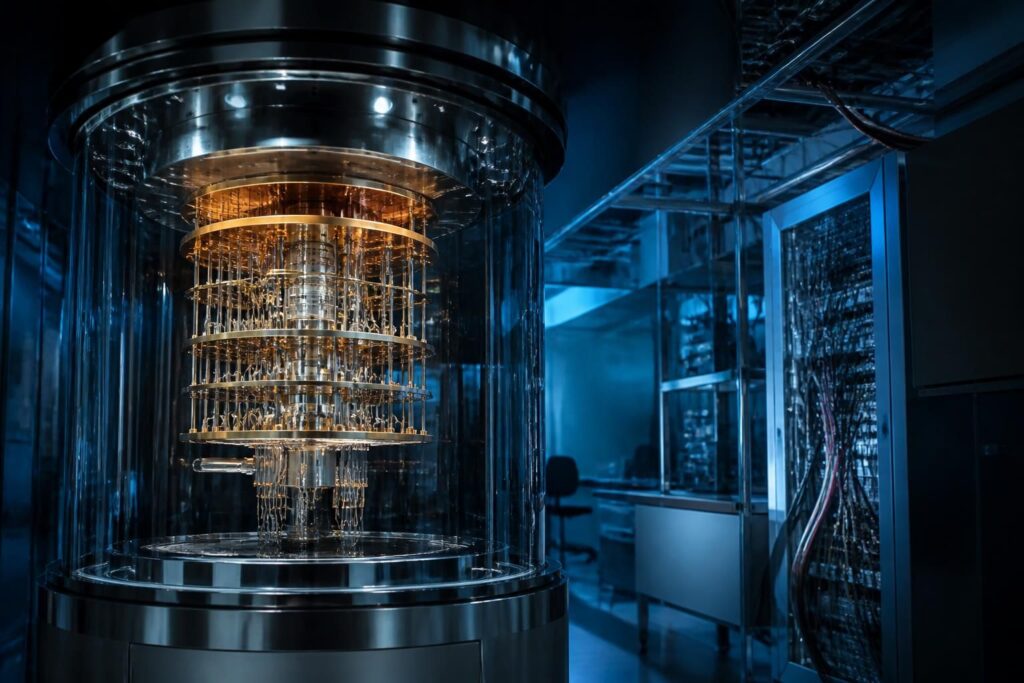
A historic announcement from China’s quantum research community
In a development that has caught the attention of the global tech community, Chinese researchers have unveiled what they describe as the world’s first dual-core quantum computer. Unlike traditional quantum systems that rely on a single processing unit, this new architecture integrates two quantum cores working in tandem — a design that its creators argue addresses some of the most persistent challenges in the field.
The announcement represents a meaningful step forward in China’s broader ambitions to become a world leader in quantum technology. Over the past decade, the country has invested heavily in this domain, and this latest achievement signals that those investments are beginning to bear fruit in concrete, measurable ways.
What does ‘dual-core’ actually mean in quantum computing?
In classical computing, the concept of a dual-core processor is well understood: two processing units share workloads, improving speed and multitasking. In the quantum world, however, the idea is considerably more complex.
A quantum core is built around qubits — the fundamental units of quantum information — which are notoriously fragile. They are susceptible to a phenomenon called decoherence, where environmental interference causes qubits to lose their quantum state, leading to errors. By distributing the computational load across two cores, the new system aims to reduce the pressure on any single set of qubits, thereby extending their operational stability.
The architecture also allows for what researchers describe as parallel quantum processing, where different parts of a complex problem can be tackled simultaneously by each core. This is not simply a doubling of raw power; it is a qualitative shift in how quantum tasks can be structured and executed.
“The dual-core design is not just an engineering improvement — it represents a fundamentally different way of thinking about quantum computation at the hardware level.”
Why stability matters so much in quantum systems
One of the central obstacles to practical quantum computing has always been stability. Current quantum machines require extreme conditions to operate — temperatures close to absolute zero, electromagnetic shielding, and carefully controlled environments. Even under these conditions, qubits remain highly sensitive and error-prone.
The dual-core approach reportedly improves qubit coherence time, meaning qubits can maintain their quantum state for longer before errors accumulate. This is critical because longer coherence times directly translate to more reliable and complex calculations. Without sufficient coherence, quantum computers can only perform shallow computations before results become unreliable.
Chinese researchers claim their system demonstrates measurable gains in error rates compared to equivalent single-core designs. While independent verification is still pending, the preliminary data shared by the team suggests a genuine improvement rather than a marginal one.
How this fits into the global quantum race
The unveiling of this dual-core system comes at a time of intense international competition in quantum computing. The United States, the European Union, and several private companies — including IBM, Google, and IonQ — have all made significant strides in recent years.
China’s approach, however, has increasingly focused on homegrown hardware innovation rather than relying on foreign components or platforms. This strategic independence is particularly relevant given ongoing restrictions on the export of advanced semiconductor technology to China. By developing novel architectures domestically, Chinese institutions are finding ways to advance quantum capabilities through design innovation rather than raw component performance.
- IBM’s quantum roadmap targets fault-tolerant systems by the end of the decade.
- Google achieved a milestone with its Sycamore processor, claiming quantum supremacy in 2019.
- China’s Jiuzhang photonic quantum computer demonstrated advantages in specific sampling tasks.
- The new dual-core system focuses on improving stability across general-purpose quantum workloads.
Practical applications and what comes next
It is worth being measured about what this announcement means in the short term. Quantum computers, even advanced ones, are not yet ready to replace classical machines for everyday tasks. Their advantages are currently most relevant for specific problem types: optimization, cryptography, materials science simulation, and drug discovery modeling.
That said, improvements in stability and efficiency directly expand the range of problems that quantum systems can realistically tackle. A more stable dual-core machine could, for instance, handle longer quantum circuits — sequences of quantum operations — which are necessary for solving more complex real-world problems.
The research team has indicated that the dual-core architecture is scalable, meaning future iterations could incorporate additional cores as the technology matures. If this scalability holds up under rigorous testing, it could represent a genuine architectural pathway toward fault-tolerant quantum computing — the long-sought goal of the entire field.
Interpreting the announcement with appropriate caution
As with many high-profile quantum announcements, it is important to read the claims carefully. The term “first-of-its-kind” is accurate in a narrow technical sense, but the broader implications depend heavily on benchmarks that have not yet been independently reviewed by the international scientific community.
Peer review and reproducibility are the standards by which such claims earn lasting credibility. Researchers outside China will need access to the technical specifications and experimental data before the scientific community can fully assess the significance of this breakthrough. That process takes time, and it is a healthy part of how science advances.
What is clear is that China continues to push the boundaries of quantum hardware design with genuine creativity and substantial institutional support. Whether this dual-core system proves to be a landmark achievement or a stepping stone, it adds meaningfully to the global conversation about how next-generation quantum architectures should be built.