



Last updated: May 2026
What Is SpaceX AI? A Plain-English Definition
SpaceX AI refers to the artificial intelligence capabilities that now sit inside SpaceX following the company’s acquisition of xAI — Elon Musk’s AI research firm — in February 2026. xAI, best known for its Grok chatbot and large language model, operates as a subsidiary of SpaceX. The combined entity brings rockets, Starlink satellites, and frontier AI research under a single corporate roof, making SpaceX one of the most vertically integrated technology companies in the world.
In plain terms: SpaceX did not build an internal AI department from scratch. It absorbed an existing AI company — xAI — and is now working to connect that AI capability to its space infrastructure.
The SpaceX–xAI Merger: What Happened and When
The February 2026 acquisition deal
In February 2026, SpaceX completed the acquisition of xAI in an all-stock transaction, according to reporting by Reuters. The deal had been anticipated after months of speculation about consolidation across Musk’s portfolio of companies. With the acquisition closed, xAI formally became a wholly owned subsidiary of SpaceX rather than a standalone company funded separately by venture capital and strategic investors.
Deal valuation and why it is record-setting
Reuters reported the transaction valued xAI at approximately $50 billion at the time of the deal — a figure that made it one of the largest private AI M&A transactions on record. SpaceX itself was carrying a private valuation in excess of $200 billion, meaning the combined entity represented an extraordinary concentration of private-market capital in a single founder-controlled company. It is important to note these are private valuations, not figures verified by a public market listing. Financial analysts have cautioned against treating them as fixed numbers given the illiquid nature of private equity.
What xAI was before the merger
xAI was founded in 2023 by Elon Musk as a direct response to the trajectory of rivals such as OpenAI, which Musk had co-founded and later departed. According to the company’s own founding documentation (referenced in the Wikipedia entry on xAI), its stated mission was to understand the true nature of the universe — a philosophical framing that distinguished it from commercially driven AI labs. Before the SpaceX acquisition, xAI raised several billion dollars from external investors and deployed Grok as its flagship consumer-facing product through the X platform, formerly known as Twitter. Starlink revenue and Starship development had no formal relationship with xAI at that stage.
What Does xAI Actually Do? Grok and Beyond
What Grok AI is and what it can be used for
Grok is xAI’s large language model and the product most users encounter directly. It is integrated into X (formerly Twitter) and available as a standalone application. Grok can be used for many of the same tasks as other AI assistants: answering questions, summarising text, writing and editing copy, generating code, and analysing data. Where it has sought to differentiate itself is through real-time access to posts on X, giving it a feed of current information that purely web-crawl-dependent models lack. xAI has also released open-source versions of some Grok model weights, positioning the company as more transparent than some competitors.
xAI’s research mission: humans and AI working together
xAI’s public research agenda centres on what Musk has described as truth-seeking AI — systems designed to pursue accurate answers rather than politically or commercially palatable ones. The company has argued that an AI genuinely curious about the universe is less likely to become adversarial toward humanity, because understanding reality and preserving the humans who explore it are complementary goals. Whether this safety philosophy holds up in practice as models scale is a question the wider AI research community continues to debate, but it is the documented position xAI has published.
How xAI differs from OpenAI and Google DeepMind
The most direct comparison is with OpenAI, which Musk co-founded before departing amid disagreements over its direction. OpenAI transitioned toward a capped-profit structure and a close commercial partnership with Microsoft. Google DeepMind operates inside one of the world’s largest advertising businesses. xAI, by contrast, sits inside a space and infrastructure company with no legacy advertising revenue to protect. Its open-source releases represent a structural difference from OpenAI’s increasingly closed model releases, though critics note that open-sourcing earlier or smaller models while keeping frontier models proprietary is a tactic also used by Meta’s AI division.
Orbital AI: SpaceX’s Plan to Put Data Centres in Space
Why move AI computing to orbit?
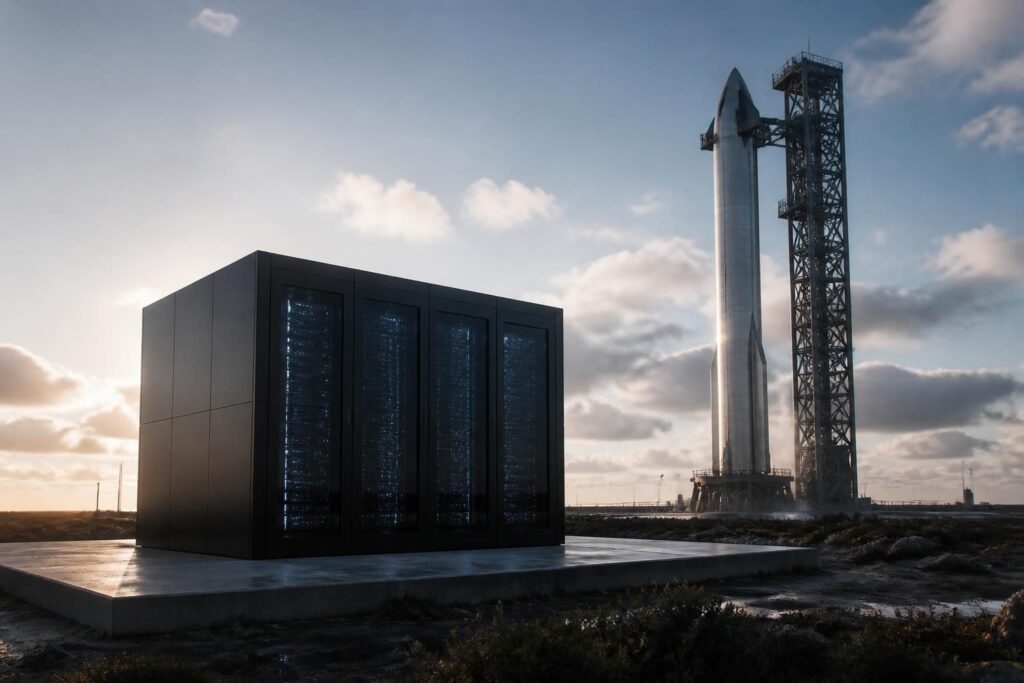
The most distinctive — and currently most speculative — element of SpaceX’s AI strategy is the idea of orbital AI infrastructure: data centres hosted on satellites rather than on the ground. The logic has several strands. Satellites in low Earth orbit are not subject to land acquisition constraints, planning permission battles, or the water rights disputes that increasingly complicate terrestrial data centre construction. They can, in principle, receive uninterrupted solar power for large portions of each orbit. And placing compute in orbit could, over time, reduce latency for certain globally distributed workloads by routing data through space rather than undersea cables.
Solar power and laser connectivity via Starlink
SpaceX’s existing Starlink constellation provides the connectivity backbone that orbital computing would rely on. Starlink satellites already use laser inter-satellite links to pass data between nodes without routing through ground stations, which reduces latency and increases resilience. A solar-powered computing satellite integrated into or alongside the Starlink network could theoretically transmit processed results back to Earth using the same laser mesh. The energy-intensive nature of AI inference and training — a point raised in ABC News reporting on SpaceX’s IPO filing in May 2026 — makes the appeal of abundant solar power in orbit particularly relevant: on the ground, AI data centres are already straining electricity grids in multiple countries.
The chip shortage problem: why SpaceX admits it is not there yet
Despite the ambition, SpaceX has publicly acknowledged that orbital AI computing is not yet feasible at meaningful scale. Reporting by Tom’s Hardware in May 2026 highlighted that SpaceX admitted it does not currently have sufficient GPU supply to build out the orbital compute infrastructure it has outlined. The global shortage of high-performance AI chips — driven by demand from hyperscalers, nation-state AI programmes, and startups simultaneously — means that even a company with SpaceX’s capital and political relationships cannot simply procure what it needs on demand. This is an important caveat: the orbital data centre is a stated ambition and a credible engineering concept, but it should not be reported as an operational or even near-term reality.
How SpaceX Plans to Fund Its AI Ambitions
Starlink as the revenue engine
Starlink is the financial engine that makes SpaceX’s AI ambitions plausible. The satellite internet service had been generating billions of dollars in annual subscription revenue before the xAI acquisition, making it the most commercially mature division of SpaceX. That recurring revenue provides the kind of predictable cash flow that sustains long-cycle R&D — the sort required to develop both frontier AI models and novel orbital computing hardware simultaneously. Without Starlink’s revenue, the xAI acquisition and the orbital infrastructure roadmap would require far greater external financing.
The IPO filing and what it reveals
In May 2026, reports emerged — covered by ABC News — that SpaceX had taken steps consistent with preparing for a public stock listing. An IPO filing would represent a significant shift for a company that has deliberately remained private far longer than most comparable technology businesses. The reported filing language reportedly touched on the energy intensity of AI workloads as both a risk and an opportunity, with SpaceX framing its space-based solar approach as a potential long-term hedge against terrestrial energy constraints. Analysts have noted that a public listing would crystallise valuations that are currently subject to significant uncertainty in private markets, but SpaceX has not confirmed a firm timeline or exchange as of the time of writing.
Starship’s role in lowering infrastructure costs
Starship, SpaceX’s fully reusable super-heavy launch vehicle, is central to making orbital AI infrastructure economically viable. The entire premise of putting compute in space collapses if launch costs remain at legacy prices. Starship is designed to reduce the cost per kilogram to orbit by an order of magnitude compared to previous rockets. Lower launch costs mean that deploying, maintaining, and eventually replacing orbital computing hardware becomes a capital expenditure that a private company can actually model. Every successful Starship test flight therefore has direct relevance to xAI’s long-term roadmap, not just to SpaceX’s core launch business.
Elon Musk’s Vision: Why Combine Space and AI?
Musk has articulated two overlapping rationales for combining space and AI under one company. The first is civilisational: he has consistently argued that making humanity multiplanetary is an existential hedge against extinction-level events on Earth. AI, in his framing, is both a tool for achieving that goal and itself an existential risk if developed without appropriate care. The second rationale is competitive and structural. Vertical integration — owning the rockets, the satellites, the connectivity, the AI models, and eventually the compute infrastructure — creates compounding advantages that no company focused on a single layer of the stack can easily replicate.
On AI safety specifically, Musk has been a vocal and somewhat contradictory voice. He was among the signatories of early open letters calling for a pause in frontier AI development, yet xAI has continued to push capability forward at pace. His documented position is that a maximally curious, truth-seeking AI is safer than one optimised for human approval — but this remains a philosophical claim rather than a proven technical result. The merger of SpaceX and xAI does not resolve those tensions; it concentrates them in a single entity with unusually broad reach across infrastructure, media (through X), and now AI research.
Frequently Asked Questions About SpaceX AI
What is SpaceX AI?
SpaceX AI refers to the artificial intelligence operations within SpaceX following its February 2026 acquisition of xAI, Elon Musk’s AI research company. xAI is now a subsidiary of SpaceX, bringing its Grok large language model and AI research capabilities under the same corporate structure as the Starlink satellite network and Starship rocket programme.
What is Elon Musk’s goal for SpaceX?
Musk has consistently stated that SpaceX’s primary goal is to make humanity a multiplanetary species, starting with establishing a self-sustaining human settlement on Mars. The integration of xAI suggests an additional aim: building the AI and computing infrastructure required to support an advanced civilisation both on Earth and eventually beyond it, with space-based data centres as a long-term component of that plan.
What can Grok AI be used for?
Grok is xAI’s conversational AI assistant and large language model. Users can apply it to answering questions, writing and editing text, generating and debugging code, summarising documents, and analysing data. Its integration with X gives it access to real-time social media content. Some versions of Grok’s model weights have been released as open-source, enabling developers to build on or fine-tune the underlying model.
What is Elon Musk’s theory on AI?
Musk’s documented position is that AI systems should be designed to seek truth and understand reality rather than to please users or serve narrow commercial interests. He argues this truth-seeking orientation makes AI less likely to become adversarial toward humanity. He also treats advanced AI as an existential risk, which is part of his rationale for wanting to develop it under his own oversight rather than leaving the field entirely to rivals such as OpenAI or Google DeepMind.