



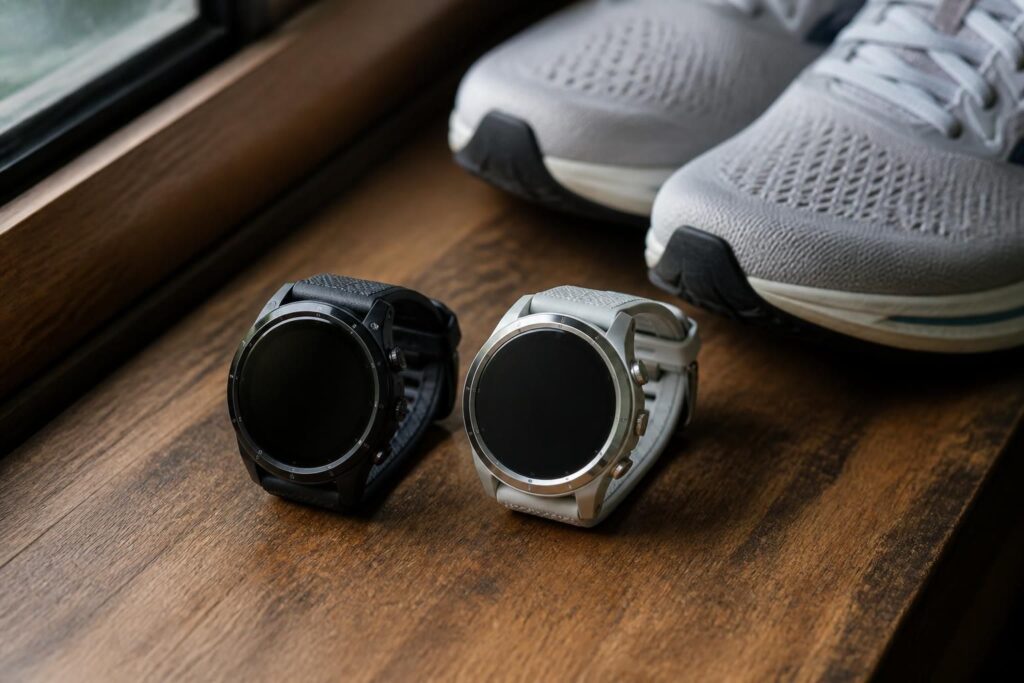
Why I Decided to Make the Switch
I had been running with the Garmin Forerunner 165 for about a year before the 170 landed on shelves. Honestly, the 165 is a solid watch. It gave me reliable GPS tracking, solid heart rate monitoring, and a bright AMOLED display that made checking stats mid-run genuinely pleasant. So when Garmin announced the 170, my first reaction was skepticism. Was this a meaningful upgrade or just a marketing refresh?
After spending several weeks putting both watches through their paces — long runs, interval sessions, and everyday wear — I have a clearer picture of what changed, what stayed the same, and who should actually bother making the switch.
What’s Actually New in the Forerunner 170
The most noticeable change is the addition of multi-band GPS support. The Forerunner 165 uses standard GPS with multi-GNSS options, but the 170 adds dual-frequency positioning, which significantly improves accuracy in challenging environments like dense urban canyons or heavily forested trails. If you run in cities with tall buildings or through tree-heavy parks, this is a real-world improvement you will actually feel.
Garmin also refined the running dynamics metrics on the 170. You now get more granular data on ground contact time balance, stride length, and vertical oscillation — metrics that were either absent or less detailed on the 165. For runners working with a coach or following a structured training plan, this additional data layer can be genuinely useful.
Battery life sees a modest bump as well. The 170 offers roughly 19 hours in GPS mode compared to the 165’s 17 hours. That gap is narrow enough that most runners will never notice it, but ultramarathon participants or those doing back-to-back long training days might appreciate the extra headroom.
One addition that surprised me was the inclusion of a built-in flashlight. It is not a feature I expected to care about, but running in low-light conditions — early morning sessions or evening workouts in winter — made it more practical than I anticipated.
What Stayed the Same (And That’s Not a Bad Thing)
Both watches share the same vibrant AMOLED touchscreen, and the display quality is essentially identical. The interface, menu structure, and Garmin Connect integration are also unchanged, which means transitioning between devices is seamless. Your training history, personal records, and health snapshots carry over without friction.
Core health features — sleep tracking, Body Battery energy monitoring, SpO2 measurement, and stress tracking — are consistent across both models. If these were the primary reasons you bought the 165, you are not missing out by staying put.
“The best running watch is the one that matches your actual training needs, not the one with the longest spec sheet.”
The Forerunner 165 remains one of the best entry-to-mid-range running watches on the market. Garmin did not make it obsolete with the 170 — they simply added a layer of precision that appeals to a more specific type of runner.
Who Should Upgrade — and Who Shouldn’t
This is the question that matters most. Here is how I break it down:
- Upgrade if you run in urban environments with tall buildings or on trails with dense tree cover, where GPS signal interference is a regular frustration.
- Upgrade if you are working with a running coach who uses advanced biomechanical data to guide your training.
- Upgrade if you run frequently in low-light conditions and would benefit from a wrist-mounted light source.
- Stay with the 165 if you run primarily in open spaces where GPS accuracy is already reliable.
- Stay with the 165 if you are a recreational runner focused on distance, pace, and heart rate rather than granular biomechanics.
- Stay with the 165 if you bought it less than a year ago and are not experiencing any performance frustrations.
The price difference between the two models is also worth factoring in. The 170 typically retails at a premium of around $50 to $70 over the 165. For some runners, that gap is trivial. For others, it is money better spent on new shoes or a race entry fee.
My Honest Take After Weeks of Testing
Switching to the Forerunner 170 felt like a natural progression rather than a dramatic leap. The multi-band GPS improvement was the single most impactful change in my daily experience — I noticed fewer erratic route traces on my city runs almost immediately. The running dynamics data has pushed me to pay more attention to my form, which I suspect will pay dividends over time.
That said, if I had bought the 165 six months ago, I would not feel compelled to upgrade. The 165 is not broken. It is a refined, capable device that does exactly what most runners need. The 170 is for those who have bumped up against its limitations or who are ready to invest in a more data-rich training experience.
Garmin has a habit of releasing incremental updates that feel underwhelming on paper but deliver genuine value in practice. The Forerunner 170 fits that pattern. It is not a revolution — it is a thoughtful evolution aimed squarely at runners who are ready for the next level of precision.
Final Verdict
If you are on the fence, ask yourself one honest question: have you ever looked at your GPS trace after a run and been frustrated by how inaccurate it looked? If the answer is yes, the 170 is worth the upgrade. If your runs are mostly in open areas and your current data meets your needs, the Forerunner 165 remains an excellent choice that does not need replacing anytime soon.