


The energy crisis hiding inside your AI applications
Every time you ask a chatbot a question or let an algorithm sort through your photos, a massive amount of electricity is consumed behind the scenes. Data centers powering modern AI systems are among the fastest-growing sources of energy demand worldwide. According to the International Energy Agency, global data center electricity consumption could double by 2026. The situation has prompted researchers and engineers to look far beyond incremental improvements to existing chip designs.
Against this backdrop, a new generation of hardware startups is proposing a radical rethink of how computers process information — and one of the most intriguing approaches involves something called oscillator-based computing.
What is oscillator-based computing?
Traditional computers rely on transistors that switch between binary states — ones and zeros — to process data. This approach, while extraordinarily refined over decades, is fundamentally limited by the energy required to flip those switches billions of times per second. Heat builds up, cooling systems kick in, and efficiency plateaus.
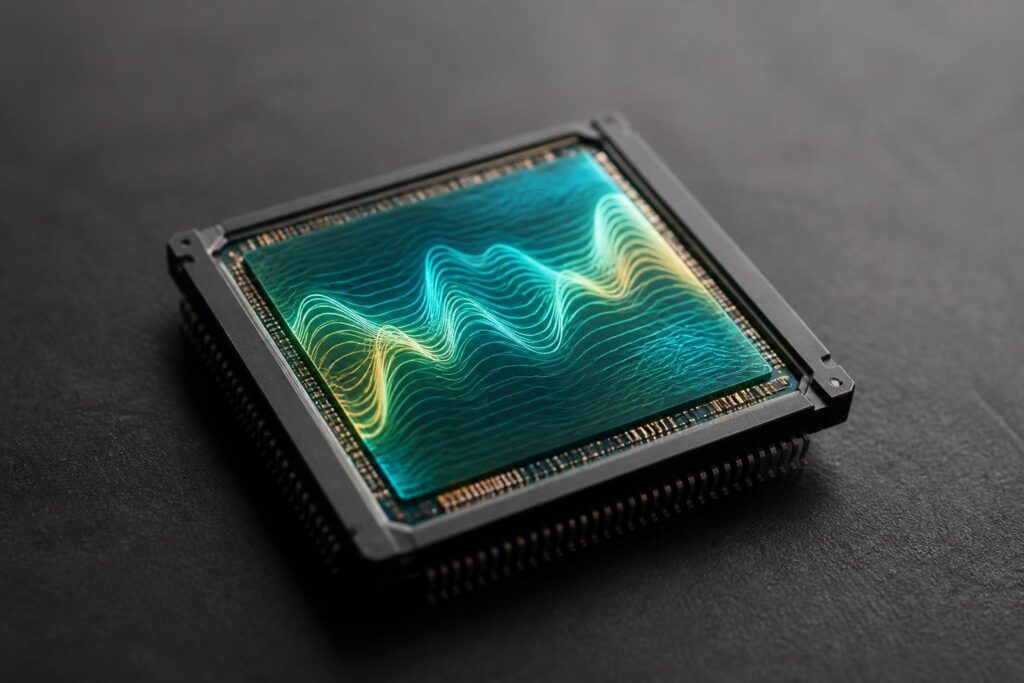
Oscillator-based computing takes a different path. Instead of binary switches, it uses networks of coupled oscillators — physical components that naturally oscillate at certain frequencies. When these oscillators are linked together, they can synchronize or desynchronize in patterns that encode and process information. The key insight is that this synchronization happens through the natural physics of the system, requiring far less externally supplied energy.
Think of it like a group of metronomes placed on a shared surface. Over time, they naturally fall into sync without any external instruction. Oscillator-based chips harness this kind of spontaneous physical behavior to perform computation.
“We are not fighting physics — we are working with it. That is where the efficiency gains come from.”
This philosophy underpins the approach taken by startups exploring analog neuromorphic architectures, which mimic the brain’s own energy-efficient signaling methods rather than forcing digital logic onto every operation.
How much more efficient could it really be?
The claim of being up to 1,000 times more energy efficient than conventional computing is striking, but it deserves some context. This figure typically refers to specific AI inference tasks — the process of running a trained model to generate an output — rather than the full training pipeline, which remains computationally intensive.
For inference workloads, which represent the vast majority of real-world AI usage, oscillator-based systems show genuine promise. Because the hardware performs computation through physical state changes rather than programmed logic gates, the energy overhead per operation can be orders of magnitude lower. Early benchmarks from prototype chips suggest that for tasks like pattern recognition, optimization problems, and certain classification tasks, the efficiency advantage is real and measurable.
It is worth noting, however, that these results are still largely from controlled laboratory settings. Scaling the technology to production-grade reliability remains an open engineering challenge.
The types of AI tasks best suited to this architecture
Not every AI workload is equally well-suited to oscillator-based hardware. The technology shines brightest in tasks that map naturally onto physical optimization — finding the lowest-energy configuration of a system is essentially what these chips do by default.
- Combinatorial optimization: routing problems, scheduling, and logistics where finding the best solution among many possibilities is key.
- Pattern recognition: identifying signals in noisy sensor data, medical imaging analysis, or anomaly detection.
- Edge AI inference: running lightweight models on battery-powered devices where energy budgets are tight.
- Graph-based problems: social network analysis, drug discovery modeling, and supply chain optimization.
For large-scale generative AI models — the kind that power modern language assistants — the architecture is less immediately applicable, though researchers are actively exploring hybrid approaches that combine oscillator-based co-processors with conventional GPUs.
Who is working on this technology?
Several startups and academic groups are advancing oscillator-based and related physics-inspired computing platforms. Companies working in the broader space of neuromorphic and analog AI chips include names like Innatera, Mythic, and others developing non-von-Neumann architectures. The oscillator-specific approach has roots in research on Ising machines — computational systems designed to solve optimization problems by mimicking magnetic spin systems.
Funding from both venture capital and government research programs has accelerated progress. The U.S. DARPA agency, for instance, has backed multiple programs exploring unconventional computing substrates, recognizing that the limits of silicon scaling — often described through the lens of Moore’s Law — are becoming increasingly apparent.
What needs to happen before this reaches the mainstream
Despite the excitement, several hurdles remain before oscillator-based AI hardware becomes a mainstream option for industry:
- Manufacturing consistency: Analog components are inherently more sensitive to fabrication variations than digital ones, making yield and reliability harder to guarantee at scale.
- Software ecosystem: Developers need familiar tools and frameworks to program these systems. Building compilers and runtime environments for novel hardware takes years of community effort.
- Benchmarking standards: The field needs agreed-upon benchmarks that allow fair comparisons between oscillator-based chips and conventional GPUs or TPUs.
- Integration pathways: Enterprises are unlikely to replace entire data center stacks overnight. Hybrid co-processor models that slot into existing infrastructure will likely be the first commercial entry point.
The trajectory, though, is encouraging. As energy costs continue to rise and the environmental footprint of AI draws more scrutiny, the incentive to adopt radically more efficient hardware has never been stronger. Oscillator-based computing may not replace the GPU tomorrow, but it represents one of the most credible long-term bets on a genuinely different — and far greener — way to run artificial intelligence.