



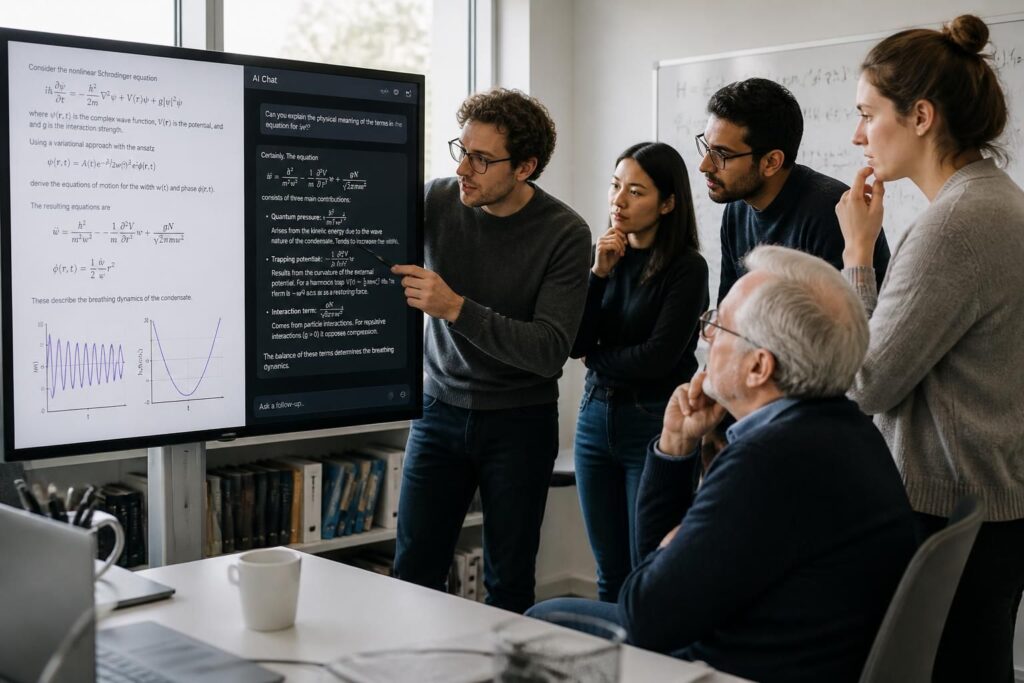
A Surprising Collaboration Between Human Brilliance and AI
When we think of groundbreaking scientific discoveries, we tend to picture lone geniuses scribbling equations on whiteboards. But a recent story out of the physics world challenges that image in a compelling way. A team led by a Nobel Prize-winning physicist has successfully used Claude AI — the large language model developed by Anthropic — to help resolve a mathematical puzzle that had remained unsolved for several decades.
The news sparked immediate interest across both the scientific community and the broader tech world, raising questions about what artificial intelligence can genuinely contribute to frontier research — and where its limits still lie.
What Was the Mathematical Problem?
While the specific details of the puzzle vary depending on the field, the general challenge involved a class of equations and theoretical structures that physicists had long known were important but couldn’t fully reconcile with existing frameworks. These kinds of problems are notoriously difficult: they sit at the intersection of pure mathematics and theoretical physics, where intuition alone rarely gets you very far.
For years, researchers had made incremental progress, but no one had managed to close the loop entirely. The problem wasn’t just computationally hard — it required a kind of creative lateral thinking that is difficult even for experienced mathematicians to summon on demand.
“We weren’t expecting the AI to hand us the answer. We were hoping it would help us see the problem differently — and it did.”
This mindset shift, according to the team, turned out to be exactly what was needed.
How Claude AI Was Used in Practice
Rather than treating Claude as a simple calculator or search engine, the researchers engaged with it more like a collaborative thinking partner. They fed it detailed descriptions of the problem, explored various mathematical formulations together, and used the model’s responses to stress-test their own assumptions.
Claude’s ability to process and reason across large bodies of mathematical literature allowed the team to quickly surface connections between concepts that might have taken months to identify manually. The AI didn’t replace the researchers’ expertise — it amplified it.
Some specific ways the team made use of Claude included:
- Generating alternative formulations of key equations to explore new solution paths
- Cross-referencing obscure mathematical theorems that turned out to be relevant
- Identifying logical gaps in earlier attempted proofs
- Drafting and refining sections of the formal write-up for peer review
This kind of workflow — where a human expert guides an AI through a complex problem domain — is increasingly being called AI-assisted research, and this case may become one of its most cited examples.
Why This Matters Beyond Physics
The implications of this collaboration extend well beyond a single solved equation. For decades, mathematicians and scientists have debated whether artificial intelligence could ever contribute meaningfully to original scientific discovery — not just pattern recognition or data analysis, but genuine intellectual progress.
This case suggests the answer is a cautious yes, under the right conditions. The key word is “assisted”: Claude didn’t autonomously solve the problem. It worked alongside researchers who already had deep domain knowledge, helping them move faster and think more broadly than they could have alone.
That distinction matters. It pushes back against two extreme narratives: the idea that AI will replace scientists entirely, and the idea that AI is only useful for mundane tasks. The reality appears to be more nuanced and, frankly, more interesting.
The Broader Trend of AI in Academic Research
This story fits into a growing pattern. Over the past two years, AI tools have begun appearing in research workflows across disciplines — from protein structure prediction with AlphaFold in biology, to automated theorem proving in mathematics, to climate modeling in environmental science.
What makes the Claude collaboration stand out is the profile of the researchers involved and the nature of the problem. Nobel laureates don’t typically publicize experimental workflows unless they’re confident in the results. The fact that this team chose to highlight Claude’s role signals a growing comfort — and credibility — around AI as a legitimate scientific tool.
Institutions and funding bodies are beginning to take notice. Several major research universities have already started developing guidelines for how AI tools can and should be used in academic work, balancing openness to innovation with concerns about reproducibility and intellectual attribution.
What This Tells Us About the Future of Problem-Solving
Perhaps the most important takeaway from this story isn’t about AI at all — it’s about how we define intelligence and creativity in problem-solving. The physicists didn’t succeed because they had access to a more powerful computer. They succeeded because they were willing to approach a stubborn problem from a new angle, using a tool that helped them think differently.
That kind of cognitive flexibility — the willingness to try unconventional methods when conventional ones have stalled — has always been at the heart of scientific progress. AI tools like Claude are now becoming part of that toolkit.
As these collaborations become more common, we can expect to see faster progress on problems that have long seemed intractable. The decades-old math puzzle solved by this team may be just the beginning of a new era in human-AI scientific partnership.