



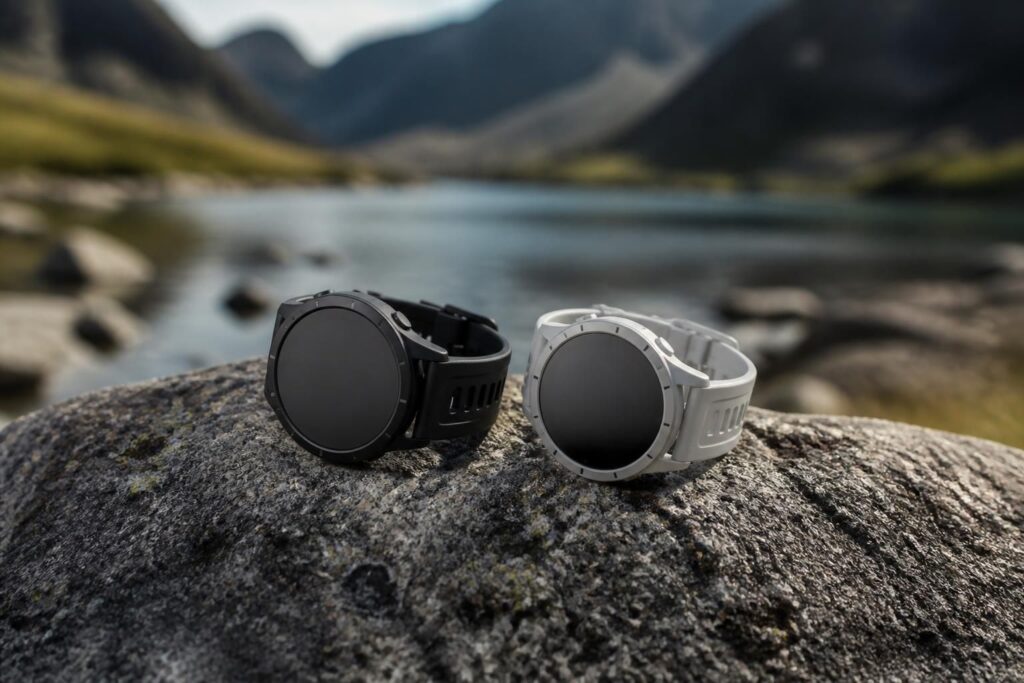
Quick verdict: Forerunner 165 vs 170 at a glance
If you are short on time, the table below captures the most important differences between the two watches. The Forerunner 165 remains a capable, affordable GPS running watch; the Forerunner 170 — which launched in mid-to-late 2025 — adds multi-band GPS, marginally refined training intelligence, and a stronger case for long-term software support. Prices below were verified in June 2025.
| Feature | Forerunner 165 | Forerunner 170 |
|---|---|---|
| UK RRP (standard) | £199 | £249 |
| UK RRP (Music) | £229 | £279 |
| Display | AMOLED touchscreen | AMOLED touchscreen |
| Battery (smartwatch mode) | Up to 11 days | Up to 10–11 days |
| Battery (GPS-only) | Up to 19 hours | Up to 20 hours |
| Multi-band GPS | No | Yes |
| Running Power | No | Yes |
| Music storage | Music SKU only (3.5 GB) | Music SKU only (4 GB) |
| Garmin Pay | Music SKU only | All models |
| Water resistance | 5 ATM | 5 ATM |
Bottom line: if the £50 price gap feels significant, the Forerunner 165 is still an excellent entry-level running watch that holds its own in 2025. If you run in urban canyons or beneath heavy tree cover and want better GPS accuracy, the 170 is the more future-proof choice.
Design, display and build quality
Size, weight and materials
Both watches share the same fundamental design language: a circular face, polymer case, and silicone strap. The Forerunner 165 weighs around 39 g without the strap, while the Forerunner 170 comes in at approximately 40 g — a difference that is entirely imperceptible on the wrist. The case diameter is 43 mm on both models, and both use a standard 20 mm quick-release strap.
Colour options differ slightly. The 165 launched in Midnight/White, Aqua, and Black, whereas the 170 introduces a Navy colourway and drops one of the earlier options depending on the retailer. Neither watch uses a sapphire lens or titanium bezel — both feature a Corning Gorilla Glass lens over a reinforced polymer bezel, which is entirely appropriate for the price bracket.
Water resistance is rated at 5 ATM on both models, meaning you can swim, shower, and run in the rain without concern. Neither is rated for open-water diving.
Screen quality and always-on display
Both the Forerunner 165 and 170 use a 1.2-inch AMOLED touchscreen — a meaningful upgrade over the MIP display found on older Garmin entry-level watches. AMOLED delivers vivid colours and excellent contrast, making glanceability in bright sunlight significantly better than its predecessors, even if the always-on display mode draws more battery than a traditional MIP panel.
Neither watch is transformatively different when it comes to the screen itself. Resolution and brightness ratings are effectively identical across the two generations. If display quality is your primary concern, you will not feel shortchanged by either model.
Battery life: how long do they actually last?
Battery life is the most-cited differentiator in head-to-head SERP results for these two watches, but the reality is more nuanced than the marketing headlines suggest. The following figures come from Garmin’s official product comparison page and should be treated as ceiling values under ideal conditions.
Smartwatch mode
The Forerunner 165 is rated for up to 11 days in smartwatch mode (with always-on display disabled). The Forerunner 170 matches this with up to 10–11 days depending on notification volume and screen wake frequency. In everyday use with regular training sessions, both watches typically land in the seven-to-nine day range before needing a charge — consistent with real-world observations from reviewers at Lifehacker, who noted the 170 lasting around eight days during a week of mixed running and commuting.
GPS-only mode
Here the 170 edges ahead in official figures: up to 20 hours of GPS recording versus 19 hours for the 165. The practical difference for most runners — even marathon trainers — is negligible. Where the 170’s GPS advantage actually matters is in accuracy, not duration, which we cover in the health and sensor section below.
Battery Saver mode
Both watches include a Battery Saver mode that reduces GPS frequency and disables background sensors, extending runtime significantly for ultra-distance events. The 170’s battery saver ceiling is rated slightly higher by Garmin’s own spec sheet, but neither watch is designed to compete with expedition-class devices like the Fenix series.
Running and training features compared
This is where the Forerunner 170 most clearly justifies its price premium — not through headline numbers, but through the depth and accuracy of its training intelligence.
Training readiness and load
Both watches offer a Training Readiness score within the Garmin Connect app, drawing on sleep quality, HRV Status, recovery time, and recent Training Load to produce a daily readiness score from 0 to 100. The underlying algorithm is the same across both models; the 170 benefits from improved GPS data feeding into distance accuracy, which marginally improves the precision of Training Load calculations over time.
HRV Status — Garmin’s tracking of overnight heart rate variability trends — is present on both watches and serves as one of the more genuinely useful long-term health indicators on either device.
Pace, cadence and running dynamics
Standard pace alerts, auto lap, and cadence tracking are available on both the 165 and the 170. The meaningful difference is Running Power: the Forerunner 170 calculates wrist-based Running Power without requiring an external footpod or chest strap, giving you an effort-based metric that accounts for gradient. The Forerunner 165 does not include Running Power — a genuine omission if you are training for hilly races or following a power-based training plan.
Race predictor and suggested workouts
Both watches provide a VO2 Max estimate and a race time predictor for distances from 5 km to marathon. Daily Suggested Workouts — adaptive sessions generated from your recent training history and readiness — are also present on both models and are among the most practical features Garmin offers at this price point. The 170 does not materially expand on the 165’s capabilities here; if Suggested Workouts and Garmin Coach integration are your main training tools, the 165 delivers them fully.
Morning Report and Daily Suggested Workouts
Morning Report — a glanceable summary of your sleep score, Body Battery energy level, weather, and the day’s suggested workout — is available on both watches. The feature set is functionally identical. Where users upgrading from the 165 to the 170 sometimes notice a difference is in the Stamina metric, which the 170 refines using Running Power data to give a more granular real-time fatigue estimate during a run.
Health and sensor accuracy
Heart rate and SpO2
Both watches use Garmin’s Elevate wrist-based heart rate monitor and include SpO2 pulse oximetry for blood oxygen saturation tracking. In standard running conditions — steady pace on open roads — wrist heart rate accuracy on both devices is competitive with the broader market. For high-intensity intervals or races where arm swing is pronounced, a chest strap or optical arm band will always outperform wrist-based monitoring regardless of which Forerunner you choose.
Sleep tracking and Body Battery
Sleep tracking on both models generates a sleep score with breakdown by sleep stage, respiratory rate, and overnight HRV. Body Battery — Garmin’s energy reserve indicator that ranges from 0 to 100 — uses this data alongside stress tracking to give a continuously updated readout of how recovered you are. The implementation is identical across the 165 and 170; neither has a hardware sensor advantage here.
GPS chipset and accuracy on the run
This is the clearest technical leap the Forerunner 170 makes over its predecessor. The 170 includes multi-band GPS (also referred to as dual-frequency GNSS), which simultaneously receives signals on two frequencies from multiple satellite constellations. The practical result is meaningfully better accuracy in environments where single-band GPS struggles: urban canyons with tall buildings, dense woodland, and underpasses.
The Forerunner 165 uses single-band GPS, which performs well in open conditions but can exhibit the track-cutting and distance discrepancies familiar to city runners. DC Rainmaker’s hands-on testing of the Forerunner 170 (published May 2026) confirmed that multi-band mode delivered tighter GPS traces in urban environments compared to single-band alternatives at the same price point — though he noted the accuracy gap narrows considerably in open-field conditions. If the majority of your running takes place in parks or on trails with clear sky views, single-band GPS on the 165 will rarely let you down.
Music and smart features
Onboard music storage
Music storage is available as a paid SKU on both watches — neither the standard Forerunner 165 nor the standard Forerunner 170 includes it. The Forerunner 165 Music offers approximately 3.5 GB of onboard storage, enough for several hundred tracks. The Forerunner 170 Music bumps this to 4 GB. Both support Spotify, Deezer, and Amazon Music for offline playlist synchronisation, as well as locally loaded MP3 files.
The storage difference is modest and unlikely to be a deciding factor unless you are a prolific playlist builder. More meaningfully, Spotify and Deezer sync requires a Wi-Fi connection and a premium subscription to the respective service.
Garmin Pay and notifications
One important distinction: Garmin Pay contactless payments are restricted to the Music SKU on the Forerunner 165 but are available on all Forerunner 170 models, including the standard version. If you want to leave your phone and wallet at home for a run and grab a coffee on the way back, the 170 gives you that flexibility from the base price of £249. On the 165, you will need to spend £229 for the Music edition to unlock Garmin Pay.
Smart notifications — incoming calls, texts, and app alerts mirrored from your phone — work identically on both watches via Bluetooth and the Garmin Connect app.
Price and value: is the 170 worth the upgrade?
Current UK prices
As of June 2025, UK RRP pricing is as follows (verified against Garmin’s UK site):
- Forerunner 165 (standard): £199
- Forerunner 165 Music: £229
- Forerunner 170 (standard): £249
- Forerunner 170 Music: £279
Street prices at major UK retailers — Wiggle, Argos, Amazon UK — tend to track the RRP closely at launch but discount during sale periods. The Forerunner 165, now superseded, occasionally appears at £170–£180 during promotions, which substantially changes the value equation.
Who should upgrade from the 165 to the 170?
The value case for the 170 rests on two arguments: multi-band GPS accuracy and software support longevity. On the second point, a widely discussed thread on the running subreddits raised a concern that many buyers overlook — Garmin has a documented tendency to slow or cease feature updates to older models once a successor launches. The Forerunner 265 received fewer new software features after the Forerunner 165 arrived; logic suggests a similar pattern will apply to the 165 now the 170 is current.
If you plan to keep your watch for three or more years, buying the current-generation 170 gives you a longer runway of firmware updates and new feature rollouts through Garmin Connect. For a one-to-two year ownership horizon, the discounted 165 represents exceptional value for money.
Forerunner 165 vs 170: our final recommendation
Best for beginners: The Forerunner 165 — particularly at its post-launch discount price — is the standout entry-level running watch for someone starting structured training. Daily Suggested Workouts, Garmin Coach, VO2 Max, and Body Battery provide far more actionable feedback than most new runners will initially need. The AMOLED screen makes it feel premium, and the 11-day battery means it disappears into your routine. If your running is mostly in parks, on treadmills, or along open roads, single-band GPS will not hold you back.
Best for intermediate runners: If you are training for a half marathon or beyond, running regularly in cities, or following a power-based training plan, the Forerunner 170 is the more capable tool. Multi-band GPS produces the accurate pace and distance data that matters when you are chasing a PB. Running Power adds a dimension of effort-based training the 165 cannot match. Garmin Pay on all models is a quality-of-life bonus that veteran runners tend to appreciate more than they expect.
Is the Forerunner 165 still worth buying now the 170 is out? Yes — at £199 (or less on promotion), it remains one of the best-value GPS running watches on the market. The features gap between the two models is real but not dramatic for the majority of recreational runners. Buy the 165 if budget is a firm constraint; buy the 170 if you want the most future-proof option at this level and your running happens in environments where GPS accuracy genuinely matters.
The overall winner is the Forerunner 170 — but only at its current price if multi-band GPS, Running Power, or universal Garmin Pay access addresses a real need in your running life. For a large slice of the target audience, the 165 at a discount is the smarter purchase in 2025.
Article last updated: June 2025. UK prices verified against Garmin.com and major UK retailers at time of publication.