



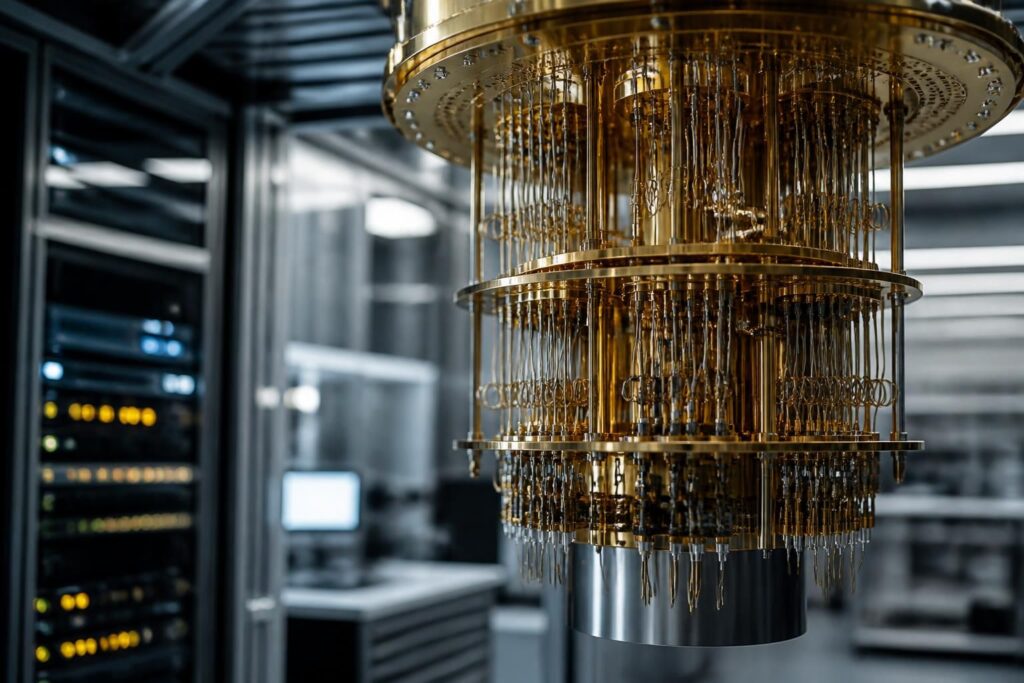
What Counts as a ‘Breakthrough’ in Quantum Computing?
Every few months, a headline announces that quantum computing has crossed some momentous threshold. The trouble is, not all thresholds are equal — and some are barely thresholds at all. Before examining what China’s 2026 systems actually achieve, it helps to establish what the field means by words like “breakthrough”, “supremacy”, and “advantage”.
Qubits, coherence, and quantum advantage — a plain-English primer
A classical computer stores information as bits — each is either 0 or 1. A qubit can be 0, 1, or a superposition of both simultaneously. That property, combined with entanglement (where qubits become correlated so that measuring one instantly tells you something about another), is what gives quantum computers their theoretical edge on certain problem types.
Two metrics matter more than raw qubit count. Qubit fidelity measures how accurately a qubit performs an operation without flipping by mistake — even a 99% single-qubit gate fidelity sounds impressive until you realise that a 100-qubit circuit with 1,000 operations has a vanishingly small chance of producing a correct result. Coherence time is the window during which a qubit maintains its quantum state before environmental noise corrupts it; longer is better, and current systems range from microseconds to milliseconds depending on the hardware type.
Quantum advantage means a quantum computer completes a specific task faster or more efficiently than any known classical algorithm. Quantum supremacy — a term coined by Google after its 2019 Sycamore demonstration — is a narrower claim: that a quantum processor solved a problem that would take a classical supercomputer an impractically long time, even if that problem has no practical use. The distinction matters enormously, because supremacy benchmarks and commercial utility are not the same thing.
Why qubit count alone is misleading
Vendors have strong incentives to announce large qubit numbers. But a 1,000-qubit chip riddled with noise may be less powerful in practice than a 50-qubit chip with excellent error rates and long coherence times. The relevant figure is the logical qubit — an error-corrected qubit built from many physical qubits working in concert. Current systems, including China’s, are still overwhelmingly in the “noisy intermediate-scale quantum” (NISQ) era, where physical qubits are abundant but logical qubits remain elusive. Bear that framing in mind when evaluating every claim that follows.
The Key Systems China Unveiled or Advanced in 2026
China’s quantum computing effort is not a single government project but an ecosystem of state-backed companies, university spin-outs, and dedicated national laboratories. In 2026, several distinct systems reached public milestones. Each deserves individual scrutiny.
Origin Wukong-180: the 180-qubit superconducting chip from Origin Quantum
Origin Quantum — headquartered in Hefei and backed by the Chinese Academy of Sciences — launched the Origin Wukong-180 in May 2026, according to coverage in the Global Times (cited here as an official primary source; independent technical corroboration is pending peer review). The chip uses superconducting qubits cooled to near absolute zero and claims 180 physical qubits arranged on a two-dimensional grid.
According to Origin Quantum, the system can complete certain quantum random circuit sampling (QRCS) tasks — the standard benchmark used since Google’s Sycamore — in a fraction of the time required by classical simulation. The company has not, as of this writing, released a peer-reviewed paper with full fidelity figures, so those specific speed claims should be treated as commercially reported rather than independently verified. What is confirmed is that the chip is accessible via Origin Quantum’s cloud platform, making it one of the first Chinese superconducting systems available to external researchers.
Hanyuan-1: the 100-qubit neutral-atom system and its commercial debut
Hanyuan-1 represents a different technological bet. Rather than superconducting circuits, it uses neutral-atom computing — individual atoms held in place by focused laser beams called optical tweezers. The approach has attracted global interest because neutral atoms can be repositioned mid-computation (enabling dynamic connectivity that fixed-grid superconducting chips cannot match) and typically achieve longer coherence times.
Hanyuan-1, developed by a Zhejiang-based team, reportedly reached 100-qubit-level computing with two-qubit gate fidelities comparable to leading Western neutral-atom systems such as QuEra’s Aquila and Pasqal’s platforms. Crucially, it began commercial cloud access in early 2026, meaning paying customers — including financial institutions and pharmaceutical companies — are actively running workloads on it. That commercial debut is arguably more strategically significant than the qubit count itself, as it marks a transition from laboratory demonstration to revenue-generating service.
Origin Pilot: China’s first quantum operating system
Hardware without software is an expensive science experiment. Origin Pilot, unveiled alongside Wukong-180, is described as China’s first dedicated quantum operating system — a layer that handles qubit scheduling, error mitigation, circuit compilation, and resource allocation across Origin Quantum’s hardware backends.
Why does a quantum OS matter? Classical cloud computing scaled partly because operating systems abstracted hardware complexity from application developers. A comparable abstraction layer for quantum hardware would allow software engineers to write quantum algorithms without managing individual qubit calibration. Origin Pilot is an early-stage effort in this direction, and its maturity relative to IBM’s Qiskit or Google’s Cirq ecosystem remains to be assessed independently. Nevertheless, it signals that China’s leading quantum companies understand that the quantum software stack is as strategically important as the chips themselves.
Zuchongzhi 3.0 / 3.2: what the superconducting line achieved
The Zuchongzhi line, developed by a team at the University of Science and Technology of China (USTC), has the strongest claim to independent validation. Earlier versions achieved peer-reviewed publication in Nature and Physical Review Letters, establishing the series as China’s most credible entry in the quantum supremacy conversation.
The Zuchongzhi 3.0 and 3.2 iterations, reported in preprints and papers in late 2025 and early 2026, advanced the QRCS benchmark further. According to the published technical work (see arXiv and associated DOIs when finalised), the system performed random circuit sampling tasks that the researchers claim would require classical supercomputers on the order of millions of years to simulate — a figure that, like Google’s analogous claim, has been contested by classical computing researchers who continue to find more efficient simulation algorithms. The honest read is that Zuchongzhi 3.2 is a genuine technical achievement on a narrow benchmark, not evidence of general-purpose quantum superiority.
What These Systems Are Actually Used For
Benchmark tasks are designed to be hard for classical computers, not to be useful in themselves. The more important question is what problems these systems can help solve today, and what they might solve within a realistic timeframe.
Optimisation problems: logistics, finance, and energy grids
Quantum computers are well-suited in theory to optimisation — finding the best solution among an astronomically large set of possibilities. Logistics (routing delivery fleets), finance (portfolio construction, risk modelling), and energy (balancing grid supply and demand) all involve this class of problem. Chinese state energy companies and financial institutions are among the early customers testing Hanyuan-1’s quantum cloud access for exactly these use cases.
The honest caveat: for most practical optimisation problems at commercially relevant scales, quantum computers in 2026 do not yet outperform the best classical heuristics. The value at this stage is closer to experimentation and capability-building than to immediate operational advantage.
Cryptography and post-quantum security implications
This is the application that attracts the most public anxiety — and the most misinformation. A sufficiently large, fault-tolerant quantum computer running Shor’s algorithm could, in principle, break RSA and elliptic-curve encryption, which secure most internet traffic today. The critical qualifier is “sufficiently large and fault-tolerant”: credible estimates suggest this would require millions of high-quality logical qubits. Current systems, including all of China’s 2026 platforms, operate with hundreds of noisy physical qubits. They pose no near-term cryptographic threat to RSA-2048.
The threat is real but temporally distant — and the defensive response is already underway. The US National Institute of Standards and Technology (NIST) finalised its first set of post-quantum cryptography (PQC) standards in 2024, based on mathematical problems believed to be hard for both classical and quantum computers. Organisations that handle long-lived sensitive data (governments, financial institutions, healthcare systems) should be migrating now, not because China’s 2026 systems are a threat, but because “harvest now, decrypt later” attacks — where adversaries collect encrypted data today to decrypt once quantum capability matures — are a realistic long-term concern.
Molecular simulation and drug discovery
One of the most credible near-term use cases for quantum computing is molecular simulation. Quantum systems are naturally suited to modelling quantum phenomena — including the behaviour of electrons in molecules — in ways that strain classical computers exponentially as molecule size grows. Quantum chemistry applications, such as simulating protein folding pathways or calculating reaction energies for novel drug candidates, represent an area where even NISQ-era devices with good error mitigation can contribute meaningfully.
Chinese pharmaceutical and materials science companies are reportedly among the early enterprise users of both Origin Wukong-180 and Hanyuan-1’s cloud platforms, targeting small-molecule simulations. Results from these commercial engagements have not yet entered the peer-reviewed literature, so independent assessment of practical advantage in this domain remains ahead of us.
Quantum high-performance computing (HPC) integration
A structural shift happening across the global quantum industry is the integration of quantum processors with classical supercomputing infrastructure — so-called quantum HPC integration. Rather than replacing classical computers, quantum processors handle specific subroutines (typically optimisation or simulation sub-problems) while classical hardware manages the broader computation. China’s National Supercomputing Centres are reportedly piloting this hybrid architecture, with Sunway AI-quantum hybrid configurations among the approaches under development. This is arguably where practical quantum value will emerge first: not as a standalone replacement for classical computing, but as an accelerator for specific bottlenecks within larger classical workflows.
How China’s Progress Compares to the US, EU, and the Rest
Quantum computing is a genuinely global competition. Framing it as a binary China-versus-US race obscures a more complex picture.
The global qubit race: where each major player stands in mid-2026
IBM Quantum has pursued a clearly communicated public roadmap, reaching 1,000+ physical qubits with its Condor and Heron processor families. IBM’s emphasis has shifted from raw qubit count toward error correction and quantum volume, with its 2025–2026 work focused on demonstrating useful quantum advantage on real-world problems rather than benchmark tasks. Google, following the Willow processor announcement in late 2024, continued to push superconducting qubit fidelity and coherence, with Willow demonstrating error rates below the threshold theoretically required for fault-tolerant operation at small scale — a milestone that the Nature paper reporting the result described carefully and the broader community has scrutinised closely.
In Europe, the EU Quantum Flagship programme funds research consortia across member states, with strong photonic and neutral-atom programmes in France (Pasqal), the Netherlands, and Germany. The UK’s National Quantum Computing Centre (NQCC) is building domestic capability with a focus on superconducting and photonic hardware. None of these programmes has announced a system at the scale of China’s 2026 platforms in terms of qubit count, though European efforts often prioritise fidelity and fault-tolerance architecture over headline numbers.
China, according to independent analysis from the Center for Strategic and International Studies (CSIS), has significantly expanded its quantum research output and patent filings over the past decade and now ranks competitively with the US in total academic publications. Whether publication volume translates into deployable, commercially useful systems is a separate and harder question.
Policy and funding: China’s Five-Year Plan quantum targets
China’s 14th Five-Year Plan (2021–2025) designated quantum technology as a “frontier” priority, directing substantial funding toward quantum computing, communication, and sensing. The 15th Five-Year Plan guidance, anticipated for 2026–2030, is expected to sustain or increase this commitment, with specific targets for fault-tolerant qubit milestones and domestic quantum chip fabrication capacity. State coordination of this kind allows sustained long-term investment in ways that market-driven programmes sometimes cannot sustain through commercially lean periods.
Where China leads, where it still trails
China leads in the scale of state-coordinated investment, in the breadth of hardware approaches being pursued simultaneously (superconducting, neutral-atom, photonic, topological), and — by some metrics — in quantum communication infrastructure, where China’s quantum satellite network and metropolitan quantum key distribution networks are genuinely ahead of Western deployments.
Where China trails is in the maturity of its quantum software ecosystem, the depth of its independent toolchain (compilers, simulators, error-correction libraries), and its access to the most advanced semiconductor fabrication equipment — a gap that US export controls have deliberately widened. CSIS analysis also notes that China’s quantum talent pipeline, while growing, is still heavily dependent on researchers trained at Western institutions, a dynamic that export restrictions and visa policies are beginning to disrupt.
Challenges China Still Needs to Solve
A balanced account of China’s quantum progress requires honest engagement with the obstacles that remain — some shared with every quantum programme globally, others more specific to China’s circumstances.
Error rates and fault-tolerant quantum computing
The central unsolved problem in quantum computing worldwide is fault tolerance. Building a logical qubit that corrects its own errors requires encoding one logical qubit across dozens or hundreds of physical qubits, with the physical qubits performing continuous error-detection cycles. This overhead is enormous: a fault-tolerant machine capable of running Shor’s algorithm against RSA-2048 may require millions of physical qubits of the quality that current systems cannot yet achieve at scale.
Error correction codes — including surface codes and other topological approaches — are well understood theoretically but fiendishly difficult to implement. China’s 2026 systems are NISQ-era devices using error mitigation (software techniques to reduce the impact of errors on results) rather than true error correction (hardware-level redundancy that eliminates errors). This is not a unique Chinese failing — it is the universal frontier of the field — but it means the gap between current systems and a cryptographically relevant quantum computer remains very large.
Supply-chain constraints and US chip export controls
Quantum chip fabrication requires specialised cryogenic control electronics, microwave components, and — for superconducting systems — dilution refrigerators. Several critical components in the supply chain involve equipment subject to US export controls, including advanced EDA (electronic design automation) tools used to design the chips themselves. These restrictions have accelerated China’s push for domestic alternatives but have simultaneously slowed development timelines and increased costs.
The effect is uneven: some components can be substituted domestically with modest quality penalty; others — particularly the most advanced fabrication equipment — remain difficult to replicate quickly. Independent analysts note that this constraint is likely to matter more as China attempts to scale toward fault-tolerant architectures that demand tighter fabrication tolerances.
Talent pipeline and independent toolchain development
Building a competitive quantum software stack — compilers, simulators, algorithm libraries, cloud infrastructure — requires software engineering talent with deep quantum domain knowledge. This workforce is globally scarce. China has invested heavily in university quantum computing programmes, but the broader software ecosystem around its hardware remains less mature than the Qiskit or Cirq communities that have had years of open-source contributions from a global developer base.
Origin Pilot represents an attempt to build this layer domestically, and China’s major technology platforms (Alibaba Quantum Lab, Baidu Research) have contributed open-source tools. But closing the software gap is a multi-year effort that runs in parallel with — and is arguably as important as — the hardware race.
What to Watch for in the Rest of 2026 and Beyond
Milestones expected by 2027: when quantum outperforms classical at scale
The field broadly agrees that 2027 milestones to watch include: demonstrations of error-corrected logical qubits at useful scale (targeted by IBM, Google, and USTC’s Zuchongzhi team); commercially verified quantum advantage on an optimisation or simulation problem of genuine economic value (not just a QRCS benchmark); and the first quantum-classical hybrid applications achieving production deployment in finance or pharmaceuticals.
China’s roadmap, as articulated through national planning documents and Origin Quantum’s published targets, anticipates advancing toward fault-tolerant prototypes within this window. Whether those prototypes will be independently verified or remain commercially reported is a key variable to watch. Peer-reviewed publication will be the credibility threshold that separates genuine milestones from press-release announcements.
It is worth being honest: the history of quantum computing is littered with milestones that seemed transformative and then proved narrower than claimed. Commercial quantum computing at scale remains genuinely uncertain in its timeline, and anyone — government, company, or analyst — who offers a confident five-year schedule for fault-tolerant advantage should be read with appropriate scepticism.
Open cloud access: how researchers worldwide can test Origin Wukong
One underreported aspect of China’s 2026 quantum strategy is the push for international cloud access to its systems. Origin Quantum’s quantum cloud platform is reportedly open to researchers outside China, following a model similar to IBM Quantum’s open-access programme (which has enrolled hundreds of thousands of users globally since 2016). If genuine open access is maintained, it would allow independent researchers to probe Origin Wukong-180’s actual fidelity and performance characteristics — producing the kind of third-party verification that strengthens, or sometimes complicates, headline claims.
Researchers interested in testing the platform directly can apply through Origin Quantum’s portal; those in the UK and EU should note that access terms and data-handling policies warrant review before uploading sensitive research workloads.
Frequently Asked Questions
Which country is leading in quantum computing in 2026?
No single country leads across all dimensions. The US maintains advantages in quantum software ecosystems, fault-tolerance research, and the commercial deployment of cloud quantum services (IBM, Google, IonQ, Quantinuum). China leads in scale of state-coordinated investment, breadth of hardware approaches, and quantum communication infrastructure. The EU and UK have strong academic programmes but less commercially deployed hardware. CSIS analysis positions the US and China as the two most significant players overall, with the EU relevant in specific hardware modalities. The honest answer is that it is genuinely contested — and the leader in 2026 may not be the leader when fault-tolerant systems arrive.
What is Origin Wukong and what can it do?
Origin Wukong-180 is a 180-qubit superconducting quantum processor developed by Origin Quantum, launched in May 2026. It can perform quantum random circuit sampling tasks — a standard benchmark — and is accessible via Origin Quantum’s cloud platform for optimisation and simulation workloads. According to Origin Quantum (commercial source, not yet independently peer-reviewed), it completes certain benchmark computations significantly faster than classical simulation. It cannot break encryption, perform general artificial intelligence tasks, or solve arbitrary large-scale problems — it is a NISQ-era device suited to specific problem types with appropriate algorithm design.
Does China’s quantum progress threaten current encryption?
Not currently, and not in the near term. Breaking RSA-2048 encryption would require a fault-tolerant quantum computer with millions of high-quality logical qubits — far beyond what any country’s systems can achieve in 2026. China’s current platforms, like all publicly known quantum systems, are NISQ devices that pose no practical cryptographic threat today. The longer-term risk is real but distant; the defensive response — migrating to NIST post-quantum cryptography standards — is already available and organisations handling sensitive long-lived data should be implementing it now as a matter of policy hygiene, not panic. The threat is best described as a planning horizon, not an imminent crisis.
Last reviewed: June 2026. The quantum computing landscape changes rapidly; readers should treat specific qubit counts and performance figures as accurate to the publication date and verify against current technical literature for subsequent developments.