



Why 2025–2026 Is a Defining Moment for Quantum Computing
Quantum computing has spent most of its life as a laboratory curiosity — impressive to physicists, bewildering to everyone else. That is changing fast. In 2025 and 2026, China moved quantum technology from the research bench into the national industrial plan, and the rest of the world is now being forced to keep up. Understanding what has happened — and what it actually means — requires separating the verified facts from the considerable hype that surrounds this field.
The shift from laboratory research to industrial policy
The fundamental shift is this: quantum computing is no longer purely a scientific competition. It has become an instrument of state strategy. China’s investments and policy moves signal that Beijing views quantum advantage — the point at which quantum machines outperform classical computers on practically useful tasks — as a strategic priority equivalent to semiconductors or space. The question is no longer whether quantum computers will matter, but who will control the ones that do.
Key concepts orient the rest of this article. A qubit is the basic unit of quantum information; unlike a classical bit, it can exist in superpositions of 0 and 1 simultaneously, enabling certain calculations to scale exponentially. Quantum supremacy refers to demonstrating that a quantum device can complete a specific task faster than any classical computer — a threshold China’s Zuchongzhi processor passed in 2021. Q-Day is the contested, speculative date on which a sufficiently powerful quantum computer could break current public-key encryption. We are not there yet, but the geopolitical stakes of getting there first are significant.
Why the UK and its allies are paying close attention
For a UK audience, this is not an abstract geopolitical story. Britain has committed £2 billion to its National Quantum Strategy through the Department for Science, Innovation and Technology (DSIT), and the National Cyber Security Centre (NCSC) has already begun issuing guidance on quantum-safe cryptography. Every month that China extends its lead in hardware, talent, and standards-setting is a month in which the West’s defensive posture becomes harder to establish. CSIS’s January 2026 analysis of China’s quantum R&D framework makes clear that the gap, while not insurmountable, is narrowing in ways that Western policymakers cannot afford to ignore.
Key Chinese Quantum Milestones in 2025–2026
China’s quantum progress in this period is real, though it comes with an important caveat: many of the most impressive figures are self-reported by state-affiliated institutions, and independent peer review has not always followed at the same pace. That said, several milestones are well-documented enough to treat as credible benchmarks.
Hanyuan 2: China’s most advanced superconducting processor
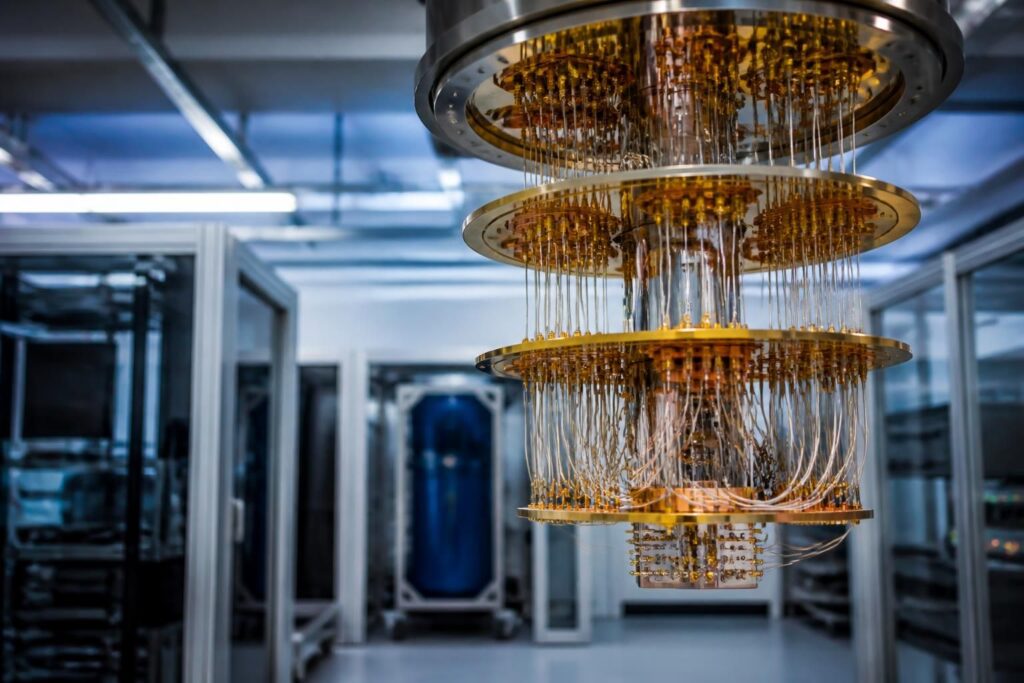
The most significant hardware milestone is Hanyuan 2, the superconducting quantum processor developed by Origin Quantum. Announced in 2025, Hanyuan 2 represents a substantial step forward in China’s superconducting qubit programme — the same modality pursued by Google and IBM. Superconducting quantum computing relies on circuits cooled to near absolute zero to exhibit quantum behaviour; the advantage is that fabrication borrows from existing semiconductor manufacturing techniques. The disadvantage is sensitivity to noise and the resulting challenge of error correction.
China’s progress here is notable because superconducting systems are currently the most mature path toward fault-tolerant quantum computing — the threshold at which error rates are low enough for reliable, large-scale computation. Independent verification of Hanyuan 2’s full specifications remains partial, and this article notes that distinction explicitly.
First commercial sale of an atomic-based quantum computer
Alongside hardware advances in superconducting systems, 2025 saw China achieve what may be an equally consequential commercial first: the sale of a quantum computer based on neutral atom technology to a paying customer. This matters because it signals that at least one Chinese quantum system has crossed the threshold from prototype to product. Neutral atom qubits are manipulated using focused laser beams and offer strong prospects for scalability with relatively low error rates. The commercial deployment — reported by Entangled Future in its May 2026 review of China’s corporate quantum landscape — puts China ahead of many Western rivals on the lab-to-market timeline, even if the device’s practical applications remain limited.
Advances in photonic and trapped-ion systems
China is not placing all its bets on superconductors. Significant investment has gone into photonic quantum computing — which encodes information in particles of light and can operate at room temperature — and trapped-ion systems, which use electrically charged atoms suspended in electromagnetic fields. The University of Science and Technology of China (USTC) has been particularly active in photonic research, building on its earlier Jiuzhang experiments. Trapped-ion systems, meanwhile, typically offer lower error rates than superconducting qubits but are harder to scale. China’s diversified approach across modalities is itself a strategic signal: rather than converging on a single bet, Beijing is funding parallel tracks.
Space-based quantum computing initiatives
China has also extended its quantum ambitions into orbit. Building on its pioneering Micius satellite — which demonstrated quantum key distribution (QKD) over thousands of kilometres — China is developing a more extensive space-based quantum communications network. While orbital quantum computing remains prospective, the satellite infrastructure being built primarily for QKD creates dual-use potential and reinforces China’s long-term positioning in quantum communications as a distinct but related field.
China’s 15th Five-Year Plan: Quantum as a National Imperative
Perhaps the most consequential development of 2026 is not a processor or a satellite — it is a policy document. China’s 15th Five-Year Plan, approved on 12 March 2026, treats quantum technology as one of a small number of “future industries” designated for state-led acceleration.
What the March 2026 plan actually says about quantum
According to analysis by postquantum.com — which reviewed the plan’s text in April 2026 — quantum computing, quantum communications, and quantum sensing are each named explicitly as priority technology areas. The plan sets targets for industrial deployment, not merely research output. This is a meaningful shift: previous Five-Year Plans funded basic research; the 15th plan is designed to push quantum systems into real-world applications in finance, manufacturing, and defence. The framing is explicitly competitive — the plan references international technology leadership as a benchmark for success.
From state funding to industrial deployment: the $15 billion+ commitment
The investment figures behind the plan are substantial. Entangled Future‘s May 2026 analysis puts total Chinese government commitment to quantum technology — across central and provincial funding — at over $15 billion. This encompasses research grants, state-owned enterprise investment, and subsidies for quantum start-ups. For context, the US National Quantum Initiative has authorised around $3 billion in federal spending over a similar period, though private-sector investment from companies such as Google, IBM, and Microsoft adds considerably to that figure. The raw numbers favour China on public expenditure; the US leads on the combination of public and private capital.
Regional quantum ecosystems and the lab-to-factory pipeline
As noted in CSIS’s January 2026 report, China’s quantum industrial policy is not concentrated in a single city. Regional quantum ecosystems have been established in Beijing, Shanghai, Hefei, and Shenzhen, each with designated research institutes, enterprise zones, and talent pipelines connected to local universities. Hefei, home to USTC, functions as China’s primary photonic quantum hub. This geographic distribution is a deliberate resilience strategy — and it mirrors the cluster model that made China’s solar and EV industries globally competitive.
China vs the US and UK: Where the Global Tech Race Actually Stands
Comparing quantum capabilities across nations is genuinely difficult. Qubit counts are not the only — or even the best — measure of capability, because qubits vary enormously in quality across modalities. A 1,000-qubit superconducting processor with high error rates may be less useful than a 100-qubit trapped-ion machine with low error rates. This comparison therefore looks at multiple indicators.
Comparing qubit counts, error rates, and real-world applications
The US currently leads on the largest publicly disclosed superconducting processors — IBM’s Condor chip exceeded 1,000 qubits in 2023, and the roadmap continues. Google’s Willow chip, announced in late 2024, demonstrated significant progress on error correction, bringing fault-tolerant quantum computing meaningfully closer. China’s Hanyuan 2 is competitive but has not yet matched these public benchmarks on independently verified error rates. Where China has arguably pulled ahead is on the integration of quantum hardware with national infrastructure — the domestic deployment pipeline described above — and on quantum communications, where its QKD satellite network has no Western equivalent.
Both the US and China remain firmly in the NISQ era (Noisy Intermediate-Scale Quantum), meaning current machines are not yet capable of the sustained, error-free computation needed for cryptographically relevant attacks on today’s encryption. The race toward fault-tolerant quantum computing is the one that matters most for security.
The UK’s £2 billion quantum commitment in context
The UK’s National Quantum Strategy, backed by £2 billion through DSIT, is ambitious by European standards but modest relative to China and the US. Britain’s comparative advantage lies in academic excellence — universities such as Oxford, Cambridge, and Bristol have world-leading quantum research groups — and in specific niches such as trapped-ion hardware (Quantinuum, headquartered in Cambridge, is a global leader). The strategic challenge for the UK is scaling academic excellence into industrial deployment fast enough to remain a genuine player, rather than a technology consumer.
China–Russia quantum collaboration and its strategic implications
A less-discussed but important dimension is the emerging quantum cooperation between China and Russia. Joint research agreements and shared infrastructure projects — particularly in quantum communications — are creating a parallel quantum ecosystem outside Western standards bodies. IFRI’s October 2024 analysis of China’s quantum ambitions flags this as a potential mechanism for standards fragmentation: if China and its partners establish competing quantum communication protocols, the interoperability assumptions underpinning global digital infrastructure could fracture.
Patent filings and talent pipelines as leading indicators
On quantum patents, China has filed more quantum-related patents than any other country for several consecutive years, according to WIPO data. Patent volume is an imperfect proxy for capability, but it reflects the density of engineering activity and signals long-term commercial intent. On talent, the quantum talent gap is a constraint for all major players, but China’s scale of STEM graduates gives it a structural advantage in raw numbers. The US retains an edge in attracting international talent — though export controls and visa restrictions introduced under the CHIPS and Science Act framework are increasingly limiting cross-border mobility in both directions.
The Security Dimension: Encryption, PQC, and the Store-Now-Decrypt-Later Threat
For most organisations, the most immediately actionable aspect of China’s quantum progress is not computing performance — it is the threat to encryption.
How quantum computers could break current encryption standards
Current public-key encryption — including RSA and elliptic-curve cryptography — relies on the computational difficulty of factoring large numbers or solving discrete logarithm problems. A sufficiently powerful quantum computer running Shor’s algorithm could break these schemes in hours rather than millennia. RSA-2048, which secures much of today’s internet traffic, is theoretically vulnerable to a fault-tolerant quantum computer with millions of error-corrected logical qubits. No such machine exists today, but the trajectory of development makes the threat credible on a multi-year horizon.
Post-quantum cryptography (PQC): NIST standards and adoption timelines
The primary defensive response is post-quantum cryptography (PQC) — mathematical algorithms designed to resist both classical and quantum attacks. In 2024, NIST finalised its first set of PQC standards, including ML-KEM (formerly CRYSTALS-Kyber) for key encapsulation and ML-DSA (formerly CRYSTALS-Dilithium) for digital signatures. These standards are now available for implementation, and NCSC guidance encourages UK organisations to begin migration planning. The challenge is that cryptographic migration is slow, expensive, and complex — major infrastructure upgrades typically take a decade or more to complete at scale.
What ‘harvest now, decrypt later’ means for governments and businesses today
The most pressing near-term threat is not a quantum computer breaking encryption in real time — it is the “harvest now, decrypt later” strategy, also called store now, decrypt later. State-level adversaries are almost certainly intercepting and storing encrypted communications today, with the intention of decrypting them once a sufficiently powerful quantum computer becomes available. Data with long-term sensitivity — government communications, defence contracts, personal health records, financial transactions — is therefore already at risk, even though today’s quantum computers cannot break it yet. This threat is real regardless of when Q-Day arrives, and it means the time to act on quantum-safe encryption is now, not at some future point when the threat becomes visible.
What China’s Quantum Advances Mean for Businesses and Policymakers
The quantum transition is not only a government problem. Any organisation that handles sensitive data, operates critical infrastructure, or depends on supply chains with long-term integrity requirements needs to be thinking about quantum risk today.
Sectors most exposed: finance, defence, pharmaceuticals, and critical infrastructure
Financial services firms face twin exposure: encrypted transaction records intercepted now could be decrypted later, and quantum-enhanced optimisation tools could reshape trading and risk modelling in ways that disadvantage unprepared competitors. Defence and intelligence agencies face the most acute risks — classified communications with decades-long sensitivity are obvious harvest-now targets. Pharmaceutical companies depend on intellectual property protection and clinical data integrity that today’s encryption secures. Critical infrastructure operators — energy grids, water systems, transport networks — rely on supervisory control systems whose cryptographic foundations have rarely been updated.
Practical steps organisations can take now
A quantum risk assessment is the logical starting point: identifying which data assets and systems would be most exposed if encryption were compromised, and over what time horizon. From there, organisations should pursue cryptographic agility — designing systems so that cryptographic algorithms can be swapped out without a full infrastructure rebuild. Adopting NIST’s finalised PQC standards for new systems now is both technically feasible and strategically prudent. Finally, organisations should review supply chain security: third-party vendors and partners may introduce cryptographic vulnerabilities that are not visible from the inside.
How UK and EU institutions are responding
NCSC has published migration guidance for UK organisations and is actively working with DSIT on a quantum-readiness framework. The European Union Agency for Cybersecurity (ENISA) has published its own PQC transition roadmap. Both bodies emphasise that the transition to quantum-ready infrastructure is a multi-year programme requiring board-level attention, not a technical patch. For UK businesses operating under financial services or critical infrastructure regulation, regulatory expectations around cryptographic resilience are likely to tighten as PQC standards become established.
Frequently Asked Questions
What is China’s most significant quantum computing breakthrough in 2025–2026?
The Hanyuan 2 superconducting processor from Origin Quantum represents China’s most advanced publicly disclosed quantum hardware milestone. Alongside it, the first commercial sale of a neutral-atom quantum computer signals that Chinese quantum technology has crossed the threshold from laboratory prototype to market-ready product — a milestone that may ultimately prove more consequential than raw qubit counts.
How does China’s quantum capability compare to the United States?
The US leads on the largest independently verified superconducting processors and on recent error-correction advances (Google’s Willow chip). China leads on quantum communications infrastructure, state-aligned deployment pipelines, and patent volume. Both nations remain in the NISQ era — neither has a fault-tolerant quantum computer capable of breaking current encryption. The gap is competitive rather than decisive, and it varies significantly by technology modality.
What is the outlook for quantum computing by the end of 2026?
By the end of 2026, the most likely developments are incremental rather than revolutionary: further improvements in qubit error rates across all major platforms, continued commercial deployment of NISQ-era machines for niche optimisation tasks, and growing adoption of post-quantum cryptography standards by governments and regulated industries. A cryptographically relevant quantum computer — one capable of breaking RSA — remains years to decades away according to most credible technical assessments, including those from CSIS and NIST.
When could quantum computers break today’s encryption?
There is no consensus on a specific Q-Day timeline, and anyone offering a precise date should be treated with scepticism. Credible estimates from technical experts range from the early 2030s to beyond 2040, contingent on breakthroughs in error correction and qubit scaling that have not yet been demonstrated. The quantum threat is real but not imminent in the sense of a functional attack being possible today. However, the harvest-now-decrypt-later threat is present right now and does not require waiting for Q-Day.