



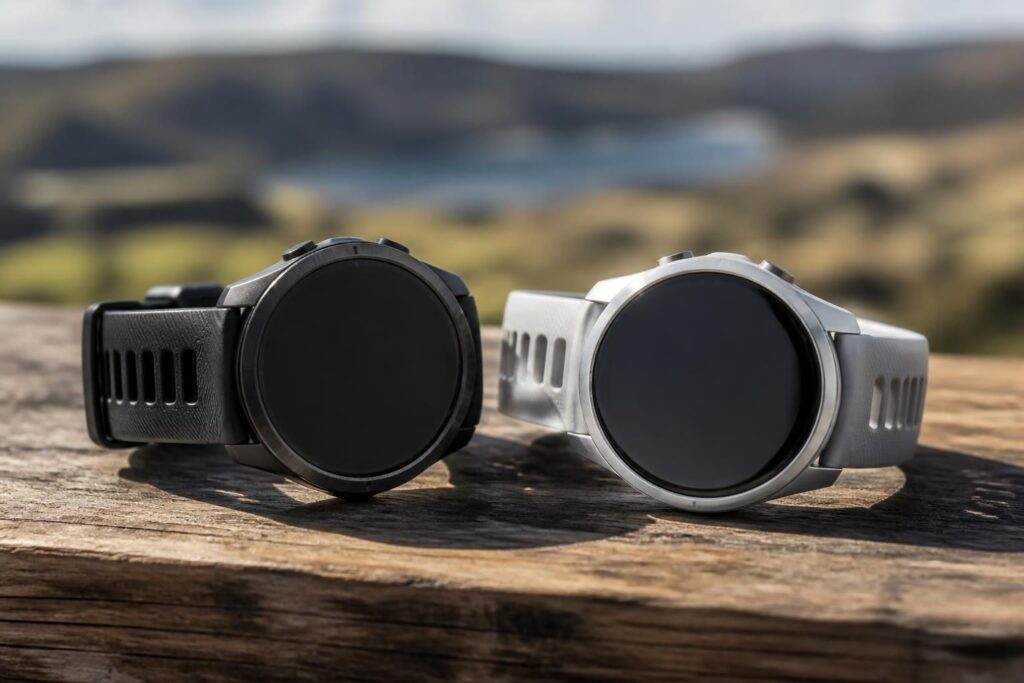
Quick Verdict: Forerunner 165 or 170 at a Glance
The Forerunner 165 and 170 share the same AMOLED display, the same Garmin software ecosystem, and a nearly identical physical shell. The meaningful difference comes down to three hardware additions on the 170: a barometric altimeter, a gyroscope for wrist-based running dynamics, and a slightly extended GPS battery window. If those two sensors don’t match your running style, the 165 is the smarter buy.
| Feature | Forerunner 165 | Forerunner 170 |
|---|---|---|
| UK RRP (standard) | £249 | £299 |
| Display | AMOLED, 1.2 in | AMOLED, 1.2 in |
| Barometric altimeter | No | Yes |
| Gyroscope | No | Yes |
| Wrist-based running dynamics | No | Yes |
| Multi-band GPS | No | No |
| Smartwatch battery | Up to 11 days | Up to 11 days |
| GPS battery | Up to 19 hours | Up to 21 hours |
| Music edition available | Yes | Yes |
| Garmin Pay | Yes | Yes |
| Water resistance | 5 ATM | 5 ATM |
Buy the 165 if you run primarily on roads, don’t need elevation data, and want to keep costs down. Buy the 170 if you run trails, care about accurate ascent/descent figures, or want wrist-based cadence and stride metrics without a chest strap or footpod.
Design, Display and Build Quality
Size, weight and materials
Both watches use a 42 mm polymer case with a reinforced bezel and a standard 20 mm quick-release silicone strap. The 165 weighs approximately 39 g; the 170 comes in fractionally heavier at around 40 g — a difference you will never notice on the wrist. Neither watch has a titanium or stainless option at this price point, so the casing is squarely plastic, which keeps weight low and cost accessible.
Screen type and resolution
Both models carry an AMOLED display at 390 × 390 pixels — the same panel Garmin first brought to the Forerunner series with the 265. It is bright enough to read in direct sunlight and produces genuinely vivid colour compared with the MIP screens that dominated older Forerunner models. Always-on mode is available on both, though enabling it reduces battery life noticeably. The display size and resolution are identical between the two watches; there is no visual upgrade to speak of when moving from the 165 to the 170.
Colour options and strap compatibility
Garmin offers the 165 in Black, Whitestone, Aqua and Lilac colourways, while the 170 launches in Black, Whitestone, and Teal. Both use a standard 20 mm lug width, so any third-party 20 mm strap — silicone, nylon, leather — will fit either watch. Water resistance is rated at 5 ATM on both models, meaning they are safe for swimming and showering but not for scuba diving.
Sensors and Hardware: The Core Difference
This is where the two watches genuinely diverge. According to Garmin’s official product comparison, the 170 adds hardware that the 165 simply does not carry — and that hardware shapes what data you get during every run.
Altimeter and elevation tracking
The Forerunner 170 includes a barometric altimeter; the 165 does not. This matters in practice because GPS-derived elevation data — the fallback method on the 165 — is notoriously unreliable. It can drift by 30 metres or more on a single run depending on atmospheric conditions and satellite geometry. A barometric altimeter measures air pressure changes in real time, producing far more accurate ascent and descent figures. If you enter hilly road races or run any trail routes, the 170’s elevation data will be meaningfully more trustworthy. Runner’s World UK’s hands-on testing of the 170 highlighted the altimeter as one of the headline reasons to choose the newer model over its predecessor.
Gyroscope and wrist-based running dynamics
The 170 also adds a gyroscope, which enables wrist-based running dynamics — cadence, stride length, vertical oscillation, and ground contact time — without any additional accessory. On the 165, these metrics are either absent or require an external sensor such as a Garmin Running Dynamics Pod. For runners who want to understand their form and reduce injury risk, this is a tangible functional difference, not a marketing addition.
Heart rate and SpO2 monitoring
Both watches use Garmin’s Elevate optical heart rate sensor for continuous HRV status tracking, resting heart rate monitoring, and pulse ox (SpO2) spot checks. Neither has clinically validated ECG functionality. Performance between the two is equivalent in this area — the sensor hardware is the same generation on both models.
GPS and multi-GNSS accuracy
Neither the 165 nor the 170 supports multi-band GPS — that feature is reserved for the pricier Forerunner 265 and above. Both watches support multi-GNSS (GPS, GLONASS, Galileo, and GPS + Galileo modes), which improves satellite acquisition in dense urban environments compared with GPS-only mode. In practical terms, expect similar GPS trace quality from both watches on your standard city run. The altimeter on the 170 doesn’t affect horizontal GPS accuracy, but it does enrich the overall activity file with reliable vertical data.
Battery Life Compared
Battery performance is broadly similar between the two models, with a small GPS-mode advantage on the 170.
Smartwatch mode
Both watches are rated at up to 11 days in smartwatch mode with always-on display disabled. In day-to-day use with notifications, heart rate monitoring, and stress tracking active, expect something closer to seven to eight days. Always-on AMOLED mode cuts this figure substantially — typically to around two days — on both models. This is one area where the gap between the 165 and 170 is effectively zero; don’t factor smartwatch battery into your decision.
GPS-only mode
Here the 170 edges ahead: Garmin rates it at up to 21 hours in GPS mode versus up to 19 hours for the 165. For most runners, this difference is academic — even ultra-marathon distances rarely push beyond 20 hours of continuous GPS recording. The practical takeaway is that neither watch will leave you battery-anxious during any standard marathon or even a long trail day.
Battery Saver mode
Both watches include a battery saver mode that disables the display and reduces sensor polling, extending operation considerably. Charge time for both is around the same — roughly 90 minutes from flat to full using the standard Garmin clip charger.
Sports and Health Features
This is where the two watches converge. Garmin has loaded the same software feature set onto both models, so the running-intelligence gap is smaller than the sensor gap might suggest.
Running metrics and training load
Both watches deliver VO2 max estimates, training load monitoring, recovery time recommendations, and training readiness scores. Training readiness combines HRV status, sleep, recovery time, and Body Battery data into a single daily readiness figure — a genuinely useful metric for runners managing cumulative fatigue. The 170 extends this with wrist-based running dynamics, giving form metrics alongside the fitness data.
Race predictor and Daily Suggested Workouts
Both models include Garmin’s race predictor, which uses your VO2 max estimate and recent training to project finish times at distances from 5K to marathon. Daily Suggested Workouts are also present on both — these are adaptive training recommendations generated each morning based on your current fitness, recovery status, and any target events you’ve entered in Garmin Connect. This feature alone makes either watch a capable training partner for runners preparing for their first race.
Sleep, stress and Body Battery tracking
Garmin’s Body Battery and sleep score algorithms run identically on both watches. Body Battery uses HRV, stress, sleep quality, and activity data to estimate your energy reserves on a 0–100 scale throughout the day. Sleep tracking includes REM, light, and deep sleep staging, plus a sleep score and nightly HRV readings. There is no feature difference here between the 165 and the 170.
Garmin Coach and structured workouts
Garmin Coach — free adaptive training plans for 5K, 10K, and half-marathon — is available on both watches. You can also load custom structured workouts from Garmin Connect or third-party platforms. Connect IQ app support is the same on both models.
Music Storage and Connectivity
Music edition differences
Both the Forerunner 165 Music and Forerunner 170 Music editions add 4 GB of onboard storage for offline music playback. You can sync playlists from Spotify, Deezer, and Amazon Music directly to the watch and listen via Bluetooth headphones without your phone. The non-music standard editions of both watches omit this storage. If you run without your phone and want music, you’ll need the Music edition of whichever watch you choose — the upgrade cost is typically around £30 to £40 above the standard edition price.
Bluetooth and ANT+ support
Both watches support Bluetooth 5.0 and ANT+, enabling connection to chest-strap heart rate monitors, footpods, cycling power meters, and other Garmin accessories. Smartphone notifications, live tracking, and automatic Garmin Connect sync all work identically on both models.
Contactless payments (Garmin Pay)
Garmin Pay is available on both the 165 and the 170. UK bank support for Garmin Pay has expanded significantly and now includes major high-street banks. It is worth checking Garmin’s current supported banks list for your specific account before purchase, as support varies by institution.
Price and Value for Money in the UK
Standard edition pricing
At the time of writing, the Forerunner 165 carries a UK RRP of £249 and the Forerunner 170 retails at £299 — a £50 gap. Given that the 170’s additional hardware is limited to a barometric altimeter and gyroscope, the value calculation is straightforward: if you’ll use those sensors regularly, the premium is reasonable; if you won’t, it isn’t. Garmin’s official UK RRP page is the most reliable source for current pricing, and both models have seen periodic discounts since launch.
Music edition pricing
The Music edition of the 165 typically sits around £279–£289 and the 170 Music around £329–£339, though retailer pricing fluctuates. The music upgrade adds meaningful functionality for phone-free runners and is worth considering alongside the base hardware decision.
Where to buy in the UK
Both watches are available through Garmin UK directly, Amazon UK, and John Lewis. John Lewis includes a two-year guarantee as standard, which is worth factoring into the comparison if long-term peace of mind matters to you. Grey-market imports are occasionally cheaper but may lack UK warranty coverage and could ship with non-UK Garmin Pay configurations.
Who Should Buy the Forerunner 165?
The Forerunner 165 is the right choice for a beginner runner or anyone who runs predominantly on roads and treadmills where elevation data is irrelevant. It is also the better pick for budget-conscious buyers who want Garmin’s AMOLED display, intelligent training features, and Garmin Pay at the lowest entry point in the current lineup.
If your running is primarily casual fitness tracking — parkruns, lunch-break jogs, occasional 10Ks — the 165 delivers every software feature the 170 does, on the same screen, for £50 less. The absence of an altimeter and gyroscope will never be felt on a flat city run. For the majority of recreational runners in the UK, the 165 represents excellent value and is absolutely still worth buying in 2025.
Who Should Buy the Forerunner 170?
The Forerunner 170 is built for the intermediate runner who wants more out of their data. If you run trails regularly, race on hilly courses, or simply want accurate ascent and descent figures for your Strava segments, the barometric altimeter alone justifies the £50 premium. The addition of wrist-based running dynamics — cadence, vertical oscillation, stride length — is a further reason to choose the 170 if you’re actively working on running form or following a structured training plan.
Runners considering an upgrade from the 165 to the 170 should think honestly about whether they currently miss elevation data or running dynamics. If you’ve been frustrated by inaccurate hills on your activity files, the 170 solves that. If you’ve never noticed, the 165 is already giving you everything you need. The 170 is not the watch to buy for a better display or longer battery — those things are identical. It is the watch to buy for better sensors.
For context, if budget allows and you want multi-band GPS alongside the altimeter and running dynamics, the Forerunner 265 sits one step up the ladder and is worth a look — though it carries a significantly higher price tag.
Frequently Asked Questions
What is the main difference between the Garmin Forerunner 165 and 170?
The Forerunner 170 adds a barometric altimeter and a gyroscope that the 165 lacks. The altimeter produces accurate elevation data on hilly runs; the gyroscope enables wrist-based running dynamics (cadence, stride length, vertical oscillation) without any additional accessory. Display, software features, Garmin Pay, and battery life in smartwatch mode are effectively identical between the two models.
Is the Garmin Forerunner 170 worth the extra cost?
It depends on your running. If you run trails or hilly road courses and want reliable elevation data, yes — the £50 premium buys genuinely useful hardware. If you run flat routes and aren’t interested in form metrics, the 165 offers the same training intelligence and the same AMOLED screen for less money. There is no software, display, or connectivity reason to choose the 170 over the 165; the justification is purely sensor-based.
How does the Forerunner 170 compare to the Forerunner 70?
The Forerunner 70 is a much older, entry-level GPS watch without an AMOLED display, Body Battery, Daily Suggested Workouts, Garmin Pay, or music storage. As DC Rainmaker’s analysis notes, the 170 is a fundamentally different generation of product — smarter software, a brighter display, and richer health tracking. If you’re coming from the Forerunner 70, the 170 is a substantial upgrade in virtually every dimension. The naming similarity is coincidental rather than indicative of a direct successor relationship.
Does the Forerunner 165 have an altimeter?
No. The Forerunner 165 does not include a barometric altimeter. It derives elevation data from GPS signals alone, which is less accurate — particularly on routes with significant climbing. If accurate elevation tracking is important to you, the Forerunner 170 (which does include a barometric altimeter) is the appropriate choice.