



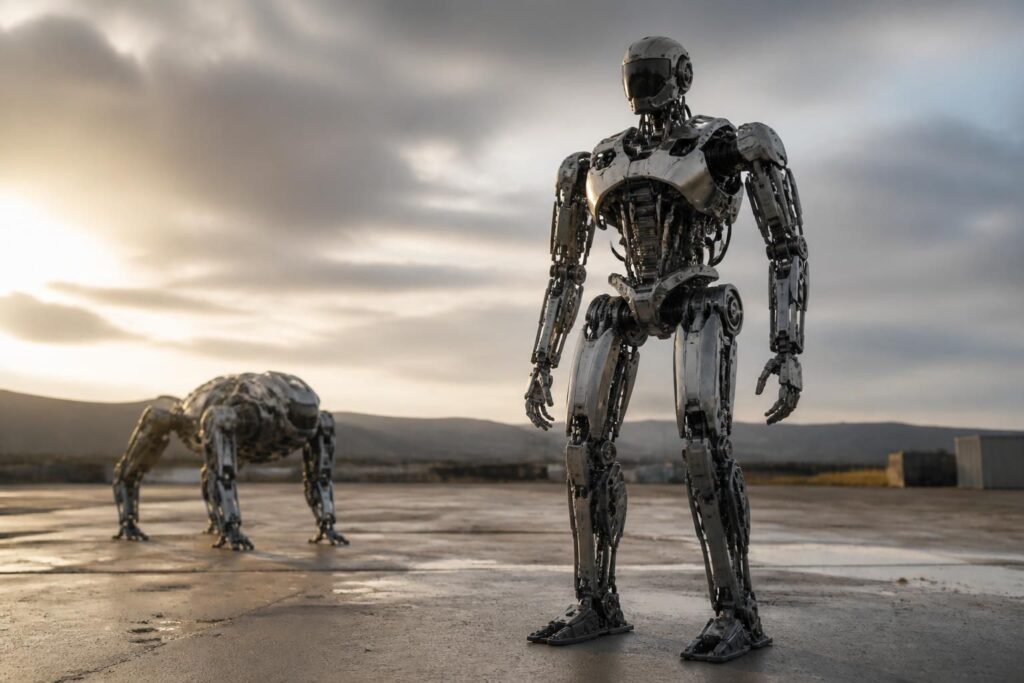
A Real-Life Transformer Steps Out of Fiction
For decades, the idea of a giant robot that could shift between multiple movement modes lived exclusively in animated series and blockbuster films. That boundary has now been pushed significantly further. A Chinese robotics company has developed a giant humanoid mech that can transition fluidly between quadrupedal bounding and bipedal walking — and the footage is as striking as anything Hollywood has produced.
The machine stands several meters tall and weighs well over a ton, making it one of the largest functional humanoid-style robots ever demonstrated publicly. Unlike many robotic prototypes that remain confined to laboratory environments, this system has been shown operating outdoors on uneven terrain, which represents a meaningful engineering milestone.
How the Switching Mechanism Actually Works
The core innovation here is not simply that the robot is large — it is the dynamic locomotion switching system that allows it to reconfigure its posture and gait in real time. When moving at speed across open ground, the robot drops forward onto its front limbs, distributing its weight across four contact points. This dramatically improves stability and allows faster travel over rough surfaces.
When the task requires upright operation — such as manipulating objects or navigating confined spaces — the robot rises onto its two rear legs and walks in a recognizably humanoid fashion. The transition between these two states takes only a few seconds and does not require the machine to stop completely.
This kind of multi-modal locomotion draws on advances in several fields simultaneously:
- High-torque actuators capable of bearing the machine’s full weight in multiple configurations
- Real-time sensor fusion combining lidar, cameras, and inertial measurement units
- Reinforcement learning algorithms trained in simulation before deployment on the physical hardware
- A structural frame engineered to handle the stress of both gaits without fatigue failure
Each of these components has been refined over years of smaller-scale robotics research, and combining them at this scale is precisely what makes the project technically significant.
The Engineering Challenges of Going Big
Scaling up a robot is not simply a matter of making the parts larger. Physics works against engineers at every step. The square-cube law means that as a robot grows in size, its volume — and therefore its weight — increases far faster than the cross-sectional area of its limbs. Structural loads become enormous, and the power requirements grow accordingly.
“The hardest part of building a large bipedal robot is not the software. It is making a structure that is simultaneously light enough to move and strong enough not to collapse under its own weight.” — robotics engineer commentary on large-scale humanoid development
Thermal management is another hidden challenge. Motors and actuators generate heat proportional to the forces they produce. At this scale, sustained operation requires active cooling solutions that add further weight and complexity. The Chinese team appears to have addressed many of these issues, though full technical specifications have not yet been publicly released.
Where Does This Fit in the Global Robotics Race?
China has been investing heavily in robotics as part of its broader industrial and technological strategy. State funding, combined with a dense ecosystem of hardware manufacturers and software developers, has allowed Chinese companies to iterate quickly. This particular mech represents a convergence of that investment with genuine engineering ambition.
On the global stage, American companies like Boston Dynamics have set the benchmark for agile legged robots, while firms such as Figure AI and Agility Robotics are pushing humanoid robots toward commercial deployment. What distinguishes the Chinese approach here is the emphasis on scale and spectacle alongside functionality — the machine is designed to be imposing as well as capable.
Whether this translates into practical applications in the near term remains an open question. Large robots face real obstacles in everyday environments: doorways, load-bearing floors, and energy infrastructure are all designed around human scale. However, there are sectors — construction, disaster response, heavy industry — where a machine of this size and versatility could offer genuine advantages.
Potential Applications Beyond the Demonstration
It would be easy to dismiss a robot of this kind as pure spectacle, but the underlying technology has tangible use cases. In disaster response scenarios, a robot that can bound quickly across rubble on four legs and then stand upright to clear debris or assist survivors would be genuinely valuable. Current search-and-rescue robots are either fast or dexterous, rarely both.
In heavy construction and infrastructure maintenance, the ability to operate in both a low, stable quadrupedal stance and an upright posture for overhead work could replace human workers in environments that are dangerous due to height, heat, or toxic exposure. Military logistics is another area where large, terrain-capable robots have attracted sustained interest and funding.
The key question for all of these applications is autonomy. A teleoperated machine, however impressive, has limited scalability. The real leap will come when systems like this can navigate, assess, and act without continuous human input — and the reinforcement learning foundations already embedded in this robot suggest that direction is being actively pursued.
What This Moment Tells Us About Robotics Progress
A few years ago, a robot of this capability and scale would have been considered a decade away. The fact that it exists today reflects how rapidly the underlying technologies — machine learning, materials science, power electronics — have matured. The gap between what researchers describe in papers and what engineers can actually build has narrowed considerably.
That said, a public demonstration is not the same as a deployable product. Reliability, maintenance costs, and operational lifespan all matter enormously in real-world contexts. The robotics field has a long history of impressive demonstrations followed by years of quiet refinement before genuine commercial viability arrives. This machine is a compelling proof of concept, and it deserves to be recognized as such — without overstating what it means for tomorrow’s world.