


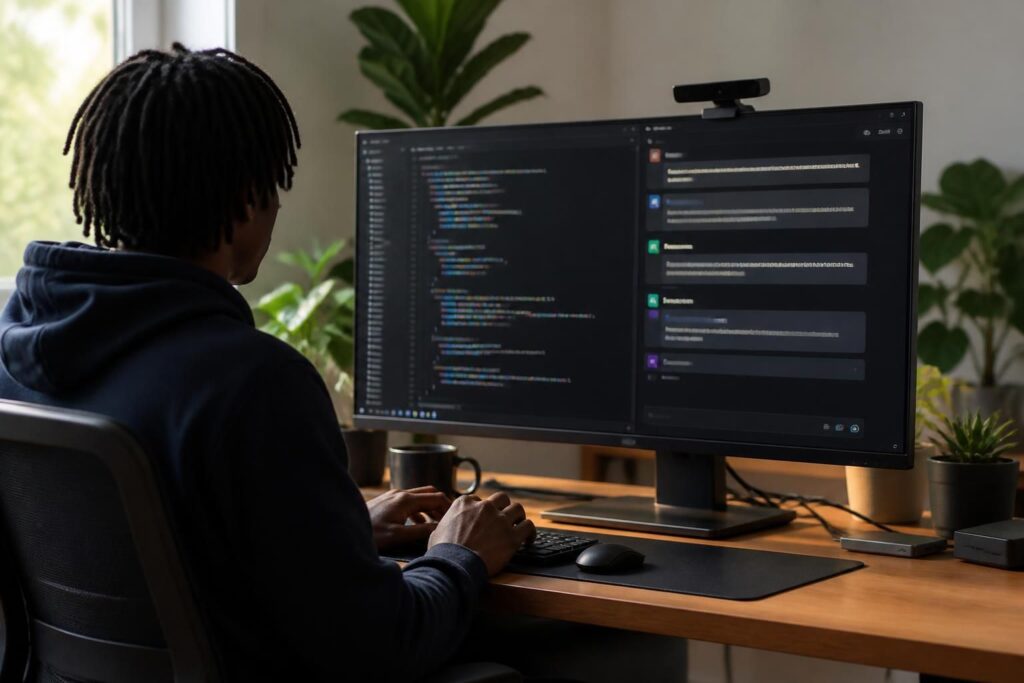
What exactly is vibe coding?
If you’ve spent any time in tech circles recently, you’ve probably heard the term vibe coding thrown around with a mix of enthusiasm and skepticism. The concept is straightforward: instead of writing traditional lines of code, you describe what you want in plain English, and an AI tool — like GitHub Copilot, Cursor, or ChatGPT — generates the actual code for you. You iterate, you tweak, you prompt again. The process feels almost conversational.
The term was popularized by Andrej Karpathy, a former Tesla AI director and OpenAI researcher, who described it as a new way of programming where you essentially go with the flow, trusting the AI to handle the syntax while you focus on the idea. It sounds liberating, and in many ways, it is.
Why so many people are drawn to it
The appeal of vibe coding is easy to understand. Building a working app or script used to require months of study, a grasp of data structures, debugging skills, and a tolerance for frustrating error messages. Now, a motivated beginner can spin up a functional prototype in an afternoon.
- No deep knowledge of syntax required to get started
- Faster iteration cycles for experienced developers
- Lower barrier to entry for non-technical founders and creators
- Immediate visual feedback keeps motivation high
- Great for exploring ideas without heavy upfront investment
For indie developers and solo founders, this shift is genuinely exciting. Tools like Replit, Bolt, and Lovable have made it possible to ship small products without hiring a full engineering team. The democratization of software creation is real, and it’s happening fast.
“The best way to predict the future is to build it — and vibe coding is making that accessible to more people than ever before.”
The major catch: you might not understand what you’re building
Here’s where things get complicated. When an AI writes your code, you get output — but you don’t necessarily get understanding. The program may work perfectly during your testing session and then fail in production in ways you can’t diagnose, because you never actually read or comprehended the logic underneath.
This is the central tension of vibe coding. The AI is generating code based on patterns in its training data, not based on a deep understanding of your specific system, your database architecture, or your security requirements. It can produce plausible-looking code that contains subtle bugs, security vulnerabilities, or inefficiencies that only surface under real-world conditions.
Experienced engineers who use AI tools tend to review every line of generated code carefully. They catch the mistakes because they know what correct code looks like. Beginners, by definition, don’t have that filter. They see code that runs and assume it’s good code — which is not always the same thing.
Security and reliability: the hidden risks
One of the most serious concerns around vibe coding is security. AI models are not security auditors. They will happily generate code that stores passwords in plain text, skips input validation, or exposes API keys in places they shouldn’t be. Unless you know to ask the right questions — or to audit the output — these vulnerabilities can end up in production systems.
Beyond security, there’s the question of reliability. AI-generated code often works for the happy path: the scenario you described in your prompt. Edge cases, error handling, and unexpected inputs are frequently ignored unless you explicitly prompt for them. A vibe-coded app might look polished on the surface while being brittle underneath.
- Always review generated code before deploying, even if it appears to work
- Use automated security scanning tools on any AI-generated output
- Test edge cases deliberately, not just the main user flow
- Never expose sensitive credentials in code repositories
- Consider having an experienced developer audit critical components
Does vibe coding have a legitimate place in professional development?
Absolutely — but context matters. For rapid prototyping, internal tools, personal projects, or proof-of-concept work, vibe coding can be a genuine productivity multiplier. Many professional developers already use AI assistants to handle boilerplate, generate test cases, or draft documentation. That’s a reasonable and efficient use of the technology.
The problem arises when vibe coding is treated as a complete replacement for software engineering knowledge. Building a consumer-facing application that handles user data, financial transactions, or health information requires more than a well-crafted prompt. It requires accountability, architectural judgment, and the ability to reason about failure modes — skills that come from experience and study, not from delegating everything to an AI.
The most effective practitioners are those who use AI tools to accelerate their work, not to avoid learning. They still understand what the code is doing. They still ask hard questions about scalability and security. The AI just helps them move faster.
How to get the most out of vibe coding responsibly
If you’re new to coding and excited about these tools, the advice isn’t to avoid them — it’s to use them with awareness. Take the time to read the code your AI generates. Try to understand at least the high-level logic, even if you don’t grasp every detail. Use the AI as a learning companion as much as a code generator: ask it to explain what it just wrote, and why.
If you’re a seasoned developer, vibe coding tools are worth integrating into your workflow thoughtfully. They can save significant time on repetitive tasks and help you explore unfamiliar libraries. Just don’t turn off your critical eye when reviewing the output.
Vibe coding is a genuine shift in how software gets made. It’s exciting, it’s accessible, and it’s only going to become more capable. But the catch is real: the easier it becomes to generate code, the more important it becomes to understand what you’re generating. That balance — between speed and understanding — is the challenge every developer, beginner or expert, now has to navigate.