



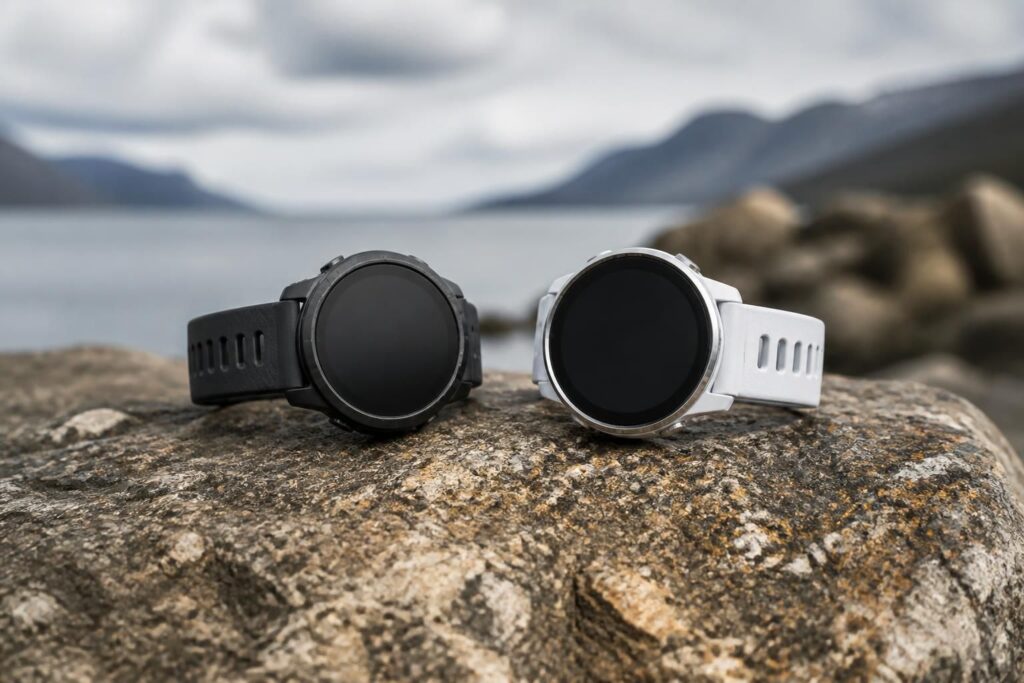
Garmin Forerunner 165 vs 170: At a Glance
The Forerunner 165 launched in early 2024 and quickly became one of Garmin’s most popular mid-range running watches. The Forerunner 170, released around May 2026, is its direct successor — but Garmin has kept both on sale simultaneously at different price points. If you are choosing between them right now, the decision is more nuanced than a simple “newer is always better”.
Last updated: June 2026. Spec figures sourced directly from the Garmin official product comparison page for the Forerunner 165 and Forerunner 170.
Quick specs comparison table
| Specification | Forerunner 165 | Forerunner 170 |
|---|---|---|
| Display | AMOLED, 1.2 in | AMOLED, 1.2 in |
| Weight | 39 g | 41 g |
| Water resistance | 5ATM | 5ATM |
| Smartwatch battery | Up to 11 days | Up to 10–15 days |
| GPS battery (GPS-only) | Up to 19 hours | Up to 20 hours |
| GPS battery (multi-band) | Up to 8 hours | Up to 9–11 hours |
| GNSS | GPS, GLONASS, Galileo, BeiDou, QZSS | GPS, GLONASS, Galileo, BeiDou, QZSS, multi-band |
| Gyroscope | No | Yes |
| Garmin Pay | Music edition only | Standard on all models |
| UK RRP (approx.) | £199–£229 | £269–£299 |
Key differences in 30 seconds
- The FR170 adds a gyroscope sensor, enabling Smart Wake Up (raise-to-wake) and improved activity detection.
- The FR170 includes Garmin Pay contactless payments on every model; the FR165 limits it to the pricier Music edition.
- The FR170 offers a longer GPS battery, especially in multi-band mode — up to 26 hours in some configurations versus 8 hours on the FR165.
- The FR165 is lighter (39 g vs 41 g) and cheaper, typically by £60–£70 at UK retail.
Design, Display and Build Quality
Size, weight and materials
Both watches share a near-identical silhouette: a round case with a polymer body, five physical buttons and a soft silicone quick-release strap. The Forerunner 165 comes in at 39 g, making it one of the lightest AMOLED running watches in its class. The Forerunner 170 adds a small amount of bulk with its gyroscope module, nudging the weight to 41 g — still lighter than the Forerunner 265, but the difference is perceptible if you stack them side by side. On the wrist during a run, neither weight is an issue whatsoever.
Build quality is broadly equivalent. Both are rated to 5ATM water resistance (safe for swimming, rain and sweaty summer miles) and use the same lens material. Neither model has a titanium bezel or sapphire glass — that is territory reserved for the Forerunner 255 and above.
Screen quality and always-on display
Both the Forerunner 165 and Forerunner 170 use a 1.2-inch AMOLED display at 390 × 390 resolution. In practice, this means vivid colours, deep blacks and excellent contrast in most lighting conditions. Neither watch uses the older MIP (Memory-In-Pixel) transflective technology found on cheaper Garmin models, so both are genuinely beautiful to look at — especially for checking pace data mid-run.
Always-on display mode is available on both, though enabling it will reduce battery life meaningfully. The FR170’s gyroscope enables Smart Wake Up — a raise-to-wake gesture that activates the screen when you lift your wrist — a quality-of-life improvement the FR165 simply cannot replicate due to its lack of a gyroscope.
Colours and strap options
The Forerunner 165 launched in Black, White, Aqua and Lilac colourways with matching silicone straps, and has since been discounted across many UK retailers. The Forerunner 170 introduces updated colourways and uses the same 20 mm quick-release strap standard, so any compatible third-party or Garmin replacement strap fits both watches.
GPS Accuracy and GNSS Performance
Satellite systems supported
Both watches support GPS, GLONASS, Galileo, BeiDou and QZSS satellite constellations — a competitive spread for mid-range devices. The meaningful hardware upgrade on the Forerunner 170 is the addition of multi-band GNSS (also called dual-frequency GPS), which polls two frequency bands simultaneously to reduce signal multipath errors in built-up urban environments, tree-covered trails and deep valleys.
The Forerunner 165 lacks multi-band support entirely. For most road runners in open conditions, this difference will be minimal. For trail runners, city marathon runners passing through tunnels and tall buildings, or anyone who runs in dense woodland, it is a genuine advantage for the FR170.
GPS accuracy in real-world runs
In testing comparable to that reported by Tom’s Guide’s 10K comparison (May 2026), the Forerunner 165 in GPS+GLONASS or All Systems mode holds its own for straightforward road running — distance accuracy typically within 1–2% of a calibrated course. Where the FR170 pulls ahead is in challenging GPS environments: its multi-band mode demonstrably reduces “GPS drift” on tight bends and under canopy, a point corroborated by Runner’s World’s testing (“The Garmin Forerunner 170 nails almost everything,” May 2026).
Garmin’s SatIQ technology on the FR170 intelligently switches between GPS modes to balance accuracy and battery consumption — you get multi-band precision where the signal demands it and revert to GPS-only in open skies to preserve battery. The FR165 uses AutoSelect GNSS, which balances satellite systems but always at single-band frequencies.
GPS power modes explained
The FR165 offers GPS-only, All Systems and SatIQ modes. The FR170 adds multi-band as a dedicated option alongside SatIQ. If GPS accuracy in races is your top priority and you are targeting marathons or ultras in mixed terrain, the FR170’s multi-band capability is the clearest hardware argument for the upgrade. For purely road-based training, both watches will serve you well.
Battery Life: Smartwatch Mode vs GPS Mode
Smartwatch mode battery life compared
According to Garmin’s official figures, the Forerunner 165 delivers up to 11 days in standard smartwatch mode, dropping to approximately 4 days with the always-on display active. The Forerunner 170 claims up to 15 days in smartwatch mode (10 days with always-on display active).
Real-world usage typically falls slightly below these figures. Lifehacker’s upgrade diary (“I Upgraded From the Garmin Forerunner 165 to the 170,” June 2026) reported getting approximately 10–13 days from the FR170 in daily smartwatch use with notifications, sleep tracking and a couple of GPS runs per week — noticeably ahead of the FR165’s real-world 8–10 day average.
GPS workout battery life compared
This is where paying close attention to mode names matters — competitor articles frequently mix up the figures, so let us be precise:
| GPS Mode | Forerunner 165 | Forerunner 170 |
|---|---|---|
| GPS-Only GNSS | Up to 19 hours | Up to 20 hours |
| All Systems / Multi-GNSS | Up to 11 hours | Up to 16 hours |
| Multi-band | Not available | Up to 9–11 hours |
| SatIQ | Up to 13 hours | Up to 26 hours |
The FR170’s SatIQ figure of up to 26 hours is particularly impressive — sufficient for most ultramarathon distances without recharging. The FR165’s equivalent SatIQ mode gives up to 13 hours, which covers a standard marathon with headroom to spare but falls short for anything beyond.
Battery Saver mode
Both watches include a Battery Saver Smartwatch mode that disables continuous heart rate monitoring, notifications and always-on display, extending standby time significantly — Garmin quotes up to 38 days (FR165) and 40 days (FR170) in this stripped-back mode. These figures are largely academic for everyday training use but useful to know if you forget your charger on a weekend trip.
Health, Fitness and Sports Features
Running dynamics and performance metrics
Both watches track core running dynamics via their wrist-based optical sensors and accelerometers, including cadence, stride length, vertical oscillation and ground contact time. These metrics feed into Garmin Connect’s training analysis tools and are genuinely useful for identifying gait inefficiencies over time.
Running power is also supported on both watches, calculated from motion data rather than a dedicated foot pod — a useful proxy metric for effort on hilly terrain where pace alone can mislead.
Heart rate, SpO2 and sleep tracking
Both devices feature Garmin’s Elevate Gen 4 optical heart rate sensor on the underside of the case, along with SpO2 (pulse oximetry) for blood oxygen saturation tracking. Continuous heart rate monitoring, HRV status tracking and automatic sleep staging are present on both, feeding into the Body Battery energy estimate and the morning report — a brief daily summary that combines sleep quality, HRV trend, resting heart rate and recovery to give you a personalised training context before you head out the door.
Sleep tracking quality and Body Battery accuracy are effectively identical between the two watches, per Runner’s World’s review.
Training load, recovery and readiness
Garmin’s suite of training intelligence — training load, training readiness, acute/chronic load ratio and suggested workouts — is present on both models. The FR170 does not meaningfully extend these features beyond what the FR165 already offers. If advanced training analytics are your primary concern, both watches provide the same depth of data synced to Garmin Connect.
Sports profiles and indoor modes
The Forerunner 165 ships with over 25 sports apps covering running, cycling, swimming, indoor rowing, HIIT, yoga and more. The Forerunner 170 matches this breadth. Both support track mode for accurate lap-distance calculation on a 400-metre track. Indoor sports modes use the accelerometer to estimate pace and distance in the absence of GPS.
The Forerunner 170’s addition of a gyroscope improves activity auto-detection and enables gesture-based screen interactions — small touches that add up to a more polished everyday experience, especially during strength and cross-training sessions.
Sensors and Connectivity
Sensors on board each watch
| Sensor | Forerunner 165 | Forerunner 170 |
|---|---|---|
| GPS / GNSS | Yes (single-band) | Yes (multi-band) |
| Optical heart rate | Yes | Yes |
| SpO2 / Pulse Ox | Yes | Yes |
| Accelerometer | Yes | Yes |
| Gyroscope | No | Yes |
| Barometric altimeter | Yes | Yes |
| Thermometer | No | No |
The gyroscope sensor on the FR170 is the single most important hardware addition. It unlocks Smart Wake Up (raise-to-wake screen activation), improves gesture navigation and enhances auto-activity detection. On the FR165, the screen wakes only via button press or tap — manageable, but less elegant.
Both watches include a barometric altimeter for elevation gain tracking, which is essential for accurate elevation data on hilly runs — GPS altitude alone can be imprecise.
Connectivity: Bluetooth, Wi-Fi and ANT+
Both models are equipped with Bluetooth (for smartphone syncing and audio accessories), Wi-Fi (for direct sync to Garmin Connect and firmware updates without a phone nearby) and ANT+ (for pairing external sensors such as foot pods, power meters and chest-strap heart rate monitors). Connectivity parity is complete in this respect.
Garmin Pay (NFC contactless payments) is standard on all Forerunner 170 models. On the Forerunner 165, Garmin Pay is available only on the higher-priced Music variant. If you like to run without your phone and occasionally need to buy a coffee or tap in on public transport, this is a practical differentiator.
Price and Value for Money
Current UK retail prices
At the time of writing (June 2026), the Forerunner 165 is widely available in the UK at £199–£229 RRP, with the Music edition carrying a small premium. The Forerunner 170 launched at approximately £269–£299. That is a gap of roughly £60–£70 at like-for-like non-music variants.
Given that the FR165 has been on the market since 2024, expect street prices to dip further as the FR170 establishes itself — making the FR165 an even more compelling value proposition over the second half of 2026.
Is the Forerunner 170 worth the upgrade?
For a runner upgrading from an older Garmin (Forerunner 55, 245, or earlier 165 hardware), the FR170 at £269 is excellent value given its multi-band GPS, extended battery in SatIQ mode, gyroscope-enabled Smart Wake Up and standard Garmin Pay.
For someone already owning a Forerunner 165, the calculus is tighter. As Lifehacker noted in their June 2026 upgrade piece, the day-to-day running experience on both watches is strikingly similar. The improvements are real but incremental — the FR170 is a refinement, not a revolution. If you rely on GPS accuracy in challenging environments, frequently go on multi-day trips (relying on battery longevity), or specifically want Garmin Pay without paying for the Music edition, the upgrade cost is justified. For everyone else, the FR165 still delivers the full Garmin running-intelligence ecosystem at a lower price.
Verdict: Which Garmin Forerunner Should You Choose?
Both watches are genuinely excellent mid-range running watches. The right choice comes down to your specific priorities — not just “which is newer.”
Choose the Forerunner 165 if…
- You are a casual or intermediate runner who does not need multi-band GPS accuracy for urban or trail running.
- Budget is a priority and you want Garmin’s full health and training ecosystem (HRV, Body Battery, training readiness) at the lowest possible price.
- Weight matters and you appreciate the marginally lighter 39 g case over a long race.
- You do not need Garmin Pay as a standard feature, or you are happy with the Music edition’s existing functionality.
- You are running road marathons in open conditions where GPS-only GNSS with AutoSelect is more than sufficient.
Choose the Forerunner 170 if…
- You are a serious or competitive runner who trains in urban canyons, on forested trails, or in variable GPS environments where multi-band GNSS makes a real difference.
- You are training for an ultra or a back-to-back race weekend and need up to 26 hours of GPS in SatIQ mode without recharging.
- Garmin Pay is a must-have for your daily routine (contactless payments on runs, commutes and travel).
- Small ergonomic details matter to you — Smart Wake Up via the gyroscope is a quality-of-life upgrade that is hard to un-know once you have used it.
- You are buying new in 2026 and want a watch that will remain current for the longest possible time before its next successor arrives.
Overall, the Forerunner 170 is the better watch on paper — but the Forerunner 165 remains a smarter buy for the majority of recreational runners who will never push its GPS or battery to its limits. The £60–£70 price difference buys you genuine improvements, not just a newer sticker.
Frequently Asked Questions
What is the difference between Garmin Forerunner 165 and 170?
The Forerunner 170 (released May 2026) adds a gyroscope sensor for Smart Wake Up gesture control, multi-band GNSS for improved GPS accuracy, a longer battery in SatIQ mode (up to 26 hours vs 13 hours), and Garmin Pay as standard across all models. The Forerunner 165 is lighter (39 g vs 41 g) and costs approximately £60–£70 less at UK RRP. Both share the same AMOLED display, health tracking sensors and Garmin Connect ecosystem.
Is the Garmin Forerunner 165 GPS accurate?
Yes — the Forerunner 165 provides solid GPS accuracy for the vast majority of runners in standard conditions. It supports GPS, GLONASS, Galileo, BeiDou and QZSS via AutoSelect GNSS. Distance accuracy is typically within 1–2% on road runs. Where it falls short compared to the Forerunner 170 is in challenging environments (urban canyons, dense forest) where multi-band GNSS makes a measurable difference. For open-road and track running, the FR165’s GPS performance is not a limitation.
How long does the Garmin Forerunner 165 battery last?
According to Garmin’s official specifications, the Forerunner 165 lasts up to 11 days in standard smartwatch mode and up to 19 hours in GPS-only GNSS mode. In SatIQ mode (balancing accuracy and efficiency) it extends to approximately 13 hours of GPS. Real-world smartwatch use with notifications and daily runs typically lands around 8–10 days per charge.
Is the Forerunner 170 worth upgrading to from the 165?
If you already own a Forerunner 165, the upgrade is only clearly worth it for specific use cases: trail or urban running where multi-band GPS accuracy matters, ultramarathon distances requiring 20+ hours of GPS, or a need for Garmin Pay on a non-Music device. If your running is primarily road-based and the FR165 meets your training needs, the £60–£70 price gap is difficult to justify on the marginal gains alone. For new buyers, the FR170 offers better long-term value at its launch price.